Yoga is one of the greatest gifts of Indian wisdom to the world. Today, when many people hear the word yoga, they immediately think of asana, flexibility, fitness, weight loss, or physical postures. Of course, asana is an important part of yoga, but yoga is much deeper than the body alone.
Yoga is a complete way of living. It is a path of self-discipline, inner balance, mental clarity, emotional maturity, spiritual awakening, and union with the deeper Self. The ancient yogis understood that human suffering does not come only from the body. It also comes from uncontrolled desires, restless thoughts, ego, attachment, fear, wrong habits, and lack of self-awareness.
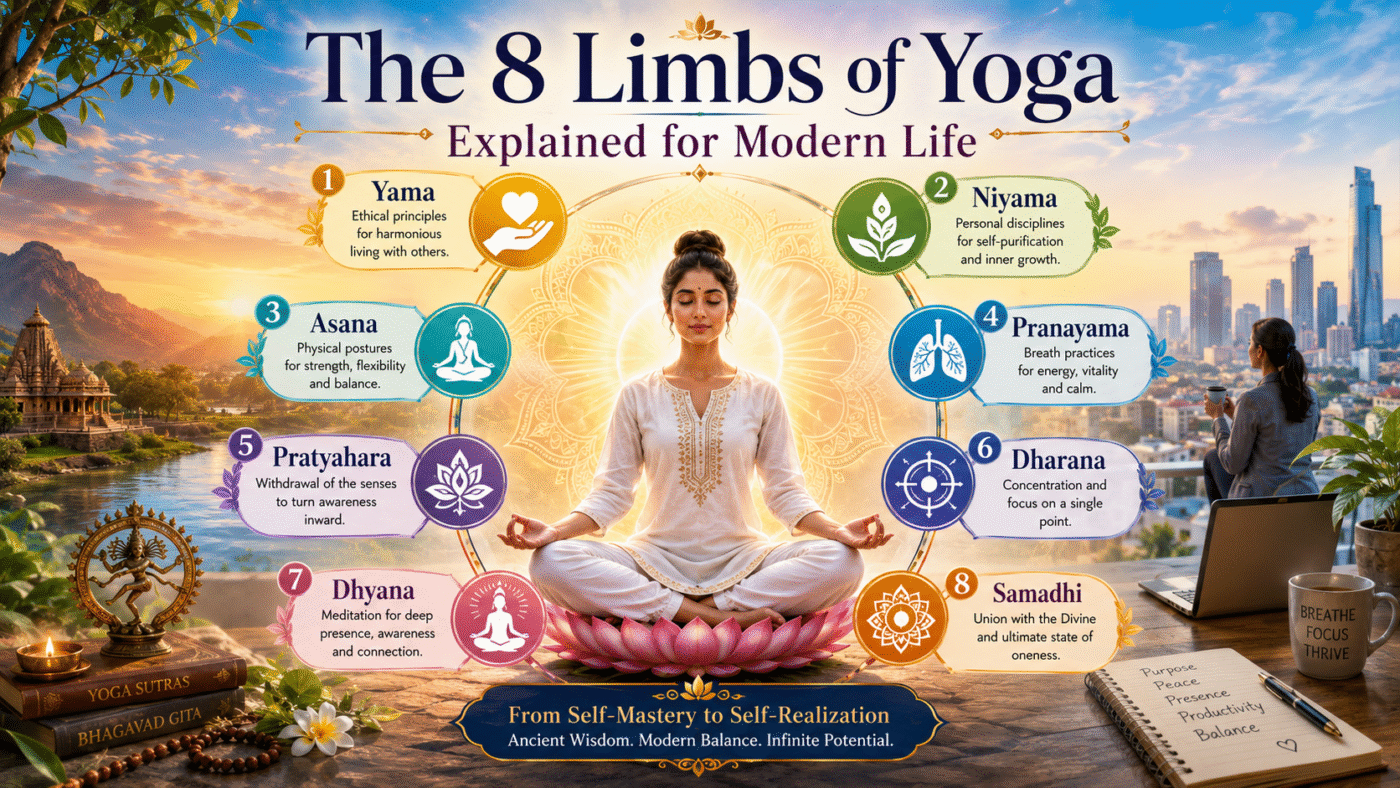
For this reason, Maharishi Patanjali presented a very systematic path known as Ashtanga Yoga, or the Eight Limbs of Yoga. These eight limbs are not only for ancient sages living in forests. They are highly practical for modern life also. Whether we are students, working professionals, parents, teachers, business people, spiritual seekers, or yoga practitioners, the eight limbs can guide us toward a more peaceful, disciplined, and meaningful life.
The eight limbs are: Yama, Niyama, Asana, Pranayama, Pratyahara, Dharana, Dhyana, and Samadhi.
Together, they show how yoga moves from outer discipline to inner awakening. They begin with our conduct in society and end with the highest state of spiritual absorption.
1. Yama: Ethical Discipline in Relationships
Yama is the first limb of yoga. It refers to ethical discipline, especially in how we relate to others and the world. Without ethics, yoga becomes incomplete. A person may perform difficult asanas, but if there is anger, dishonesty, greed, jealousy, and harmful behavior, then the deeper purpose of yoga is missing.
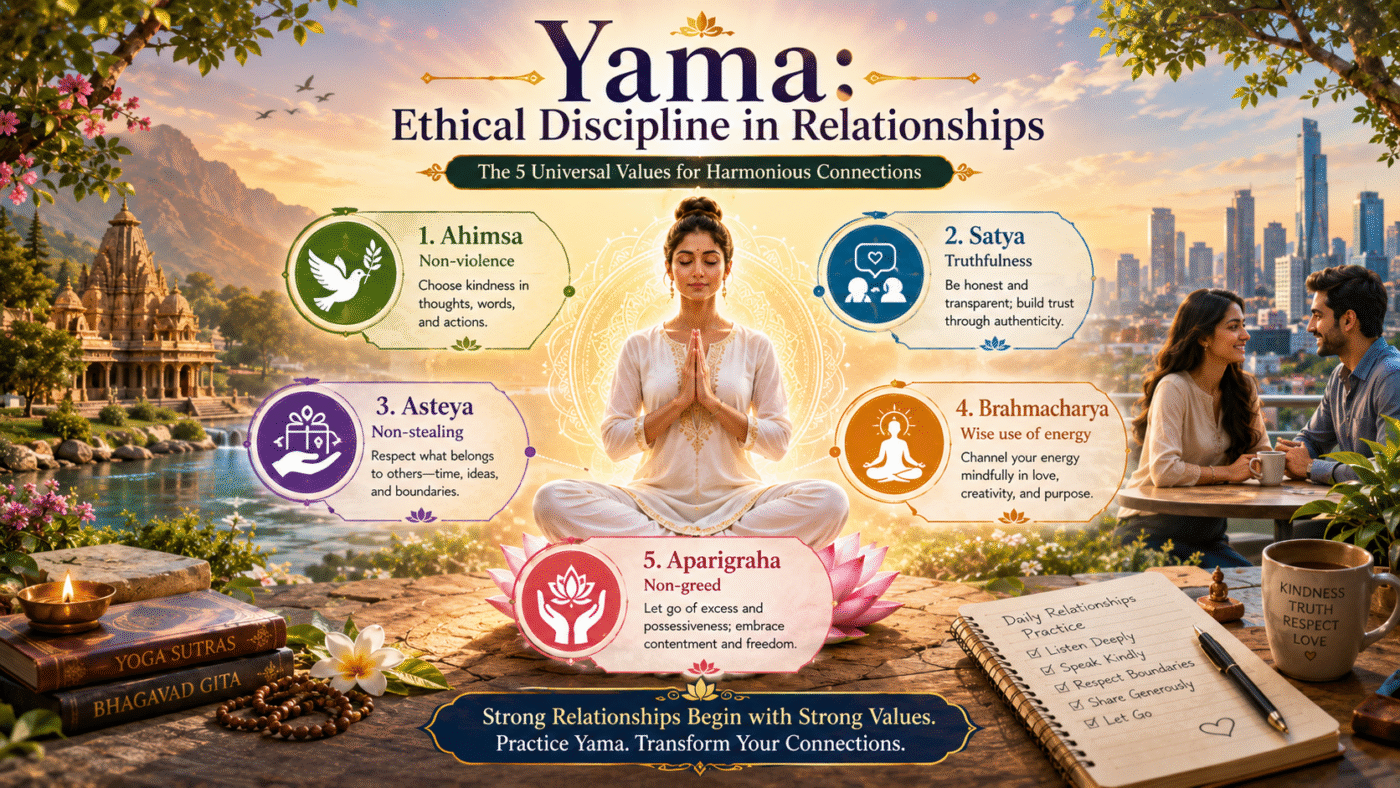
Patanjali describes five Yamas: Ahimsa, Satya, Asteya, Brahmacharya, and Aparigraha.
Ahimsa means non-violence. It is not only about not hurting physically. It also means not hurting through words, thoughts, anger, criticism, or cruelty. In modern life, Ahimsa is needed in family relationships, social media communication, workplace behavior, and even self-talk. Many people are violent toward themselves through guilt, shame, and constant negative thinking. Yoga teaches us to become kind but also strong.
Satya means truthfulness. It means living with honesty in speech, action, intention, and self-understanding. In modern life, many people wear masks. They show one thing outside and feel something else inside. Satya brings inner alignment. It asks us to speak truth with compassion and live honestly.
Asteya means non-stealing. This does not only mean not taking someone’s money or property. It also means not stealing time, credit, ideas, energy, trust, or opportunities. At work, Asteya means giving credit where it is due. In relationships, it means respecting others’ emotional space.
Brahmacharya is often understood as celibacy, but in a broader sense, it means wise use of energy. Modern life wastes energy through excessive screen time, uncontrolled desire, gossip, overeating, overthinking, and emotional drama. Brahmacharya teaches conservation and redirection of energy toward higher purpose.
Aparigraha means non-hoarding or non-greed. Modern society encourages endless consumption. We keep buying, collecting, comparing, and wanting more. Aparigraha teaches simplicity. It helps us understand that peace does not come from having more things, but from needing less.
Yama is the foundation of yoga because it purifies our relationship with the world.
2. Niyama: Personal Discipline and Inner Purity
Niyama is the second limb of yoga. While Yama guides our relationship with others, Niyama guides our relationship with ourselves. It is personal discipline, self-purification, and inner refinement.
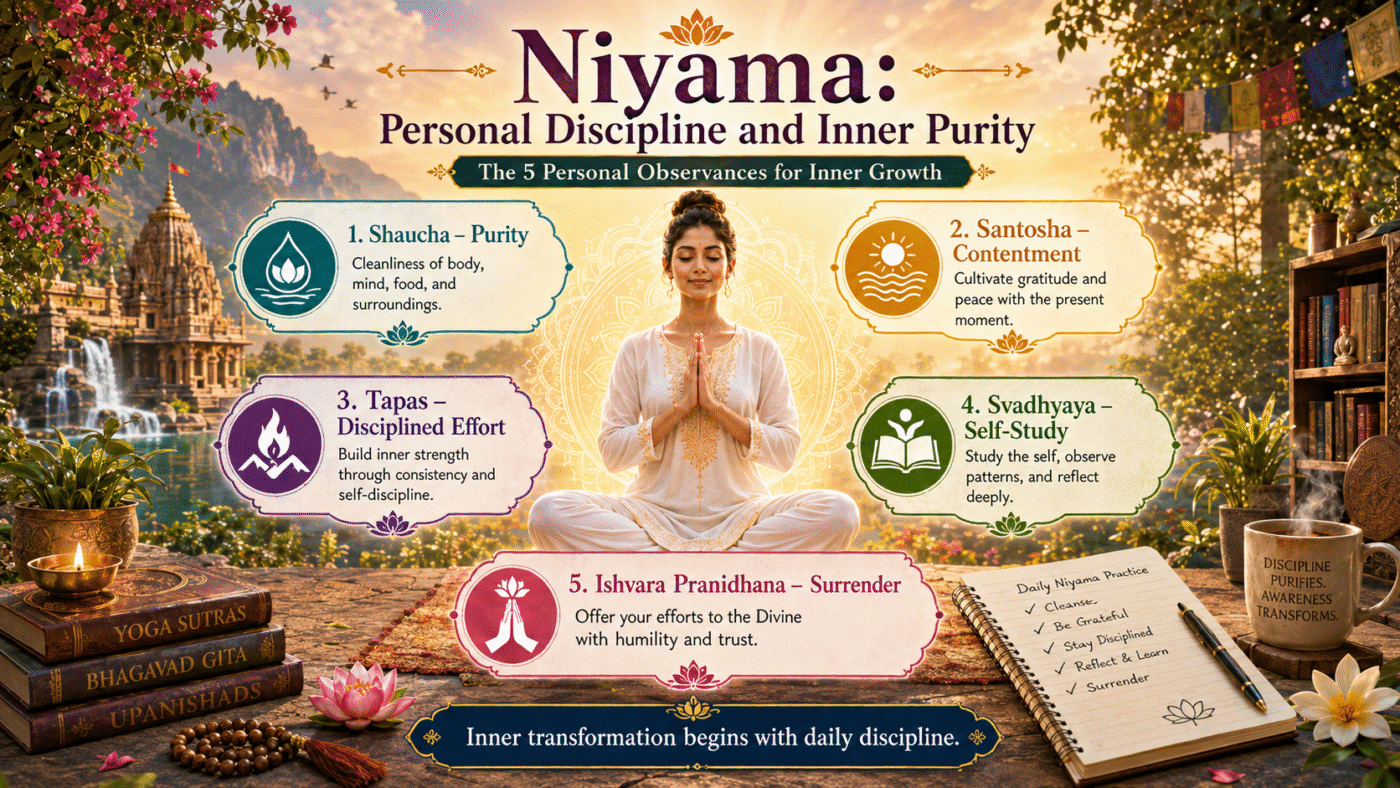
The five Niyamas are Shaucha, Santosha, Tapas, Svadhyaya, and Ishvara Pranidhana.
Shaucha means purity. It includes cleanliness of body, food, environment, thoughts, emotions, and lifestyle. In modern life, Shaucha may mean keeping the body healthy, eating sattvic food, maintaining cleanliness at home, reducing mental clutter, and avoiding toxic content.
Santosha means contentment. It does not mean laziness or lack of ambition. It means being peaceful with what is present while working sincerely for growth. Many people suffer because of constant comparison. Santosha teaches gratitude and inner satisfaction.
Tapas means disciplined effort, inner fire, and self-control. Without Tapas, no real progress is possible. Whether it is yoga practice, study, health, meditation, or spiritual life, consistency is needed. Tapas means doing what is right even when the mind resists.
Svadhyaya means self-study and study of sacred wisdom. It includes reading scriptures, reflecting on life, observing one’s thoughts and behavior, and understanding patterns. In modern life, Svadhyaya is very important because many people live unconsciously. They blame others without understanding their own habits.
Ishvara Pranidhana means surrender to the Divine, higher consciousness, or universal intelligence. It teaches humility. We do our best, but we do not become egoistic or overly attached to results. This is very useful in modern stressful life, where people try to control everything.
Niyama creates personal strength, purity, and spiritual direction.
3. Asana: Steady and Comfortable Posture
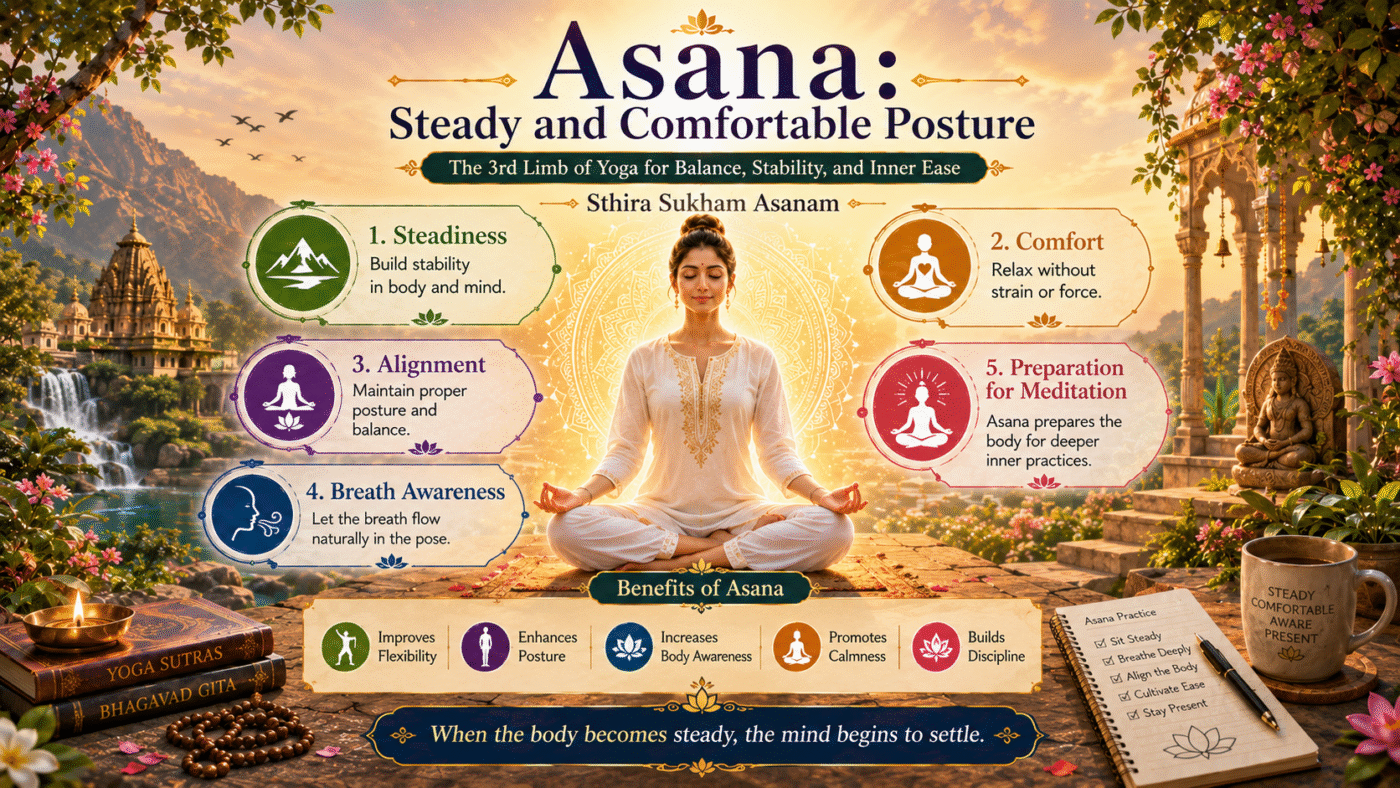
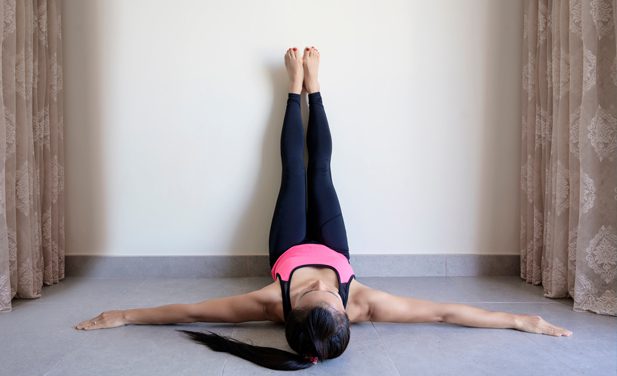
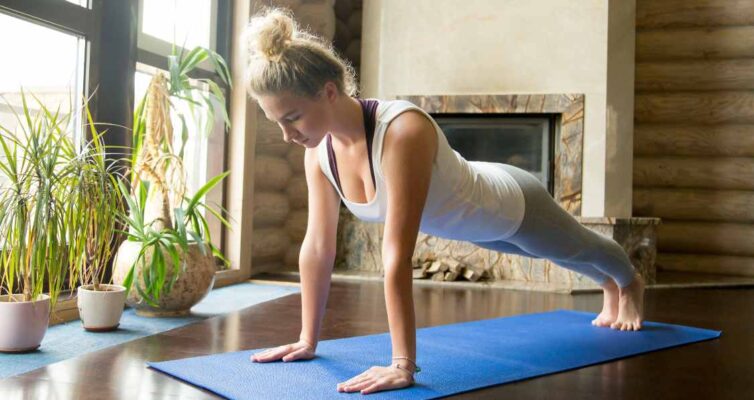
Asana is the third limb of yoga and the most widely known today. But in classical yoga, asana is not mainly about acrobatics or body display. Patanjali describes asana as a posture that is steady and comfortable.
The purpose of asana is to prepare the body for meditation. A restless, stiff, weak, or unhealthy body can disturb the mind. Through regular asana practice, the body becomes stronger, more flexible, balanced, and relaxed. The nervous system becomes calmer. Breath becomes smoother. Mind becomes more focused.
In modern life, asana is extremely useful because many people suffer from sedentary lifestyle, poor posture, back pain, neck stiffness, obesity, stress, anxiety, and lack of body awareness. Simple yogic postures can improve circulation, digestion, spine health, joint mobility, and mental relaxation.
But we should remember that asana should be practiced with awareness, not ego. The aim is not to compete with others. The aim is to become more connected with the body and breath.
A person who practices asana mindfully learns patience, discipline, body sensitivity, and balance. In this way, asana becomes meditation in movement.
4. Pranayama: Regulation of Breath and Life Energy
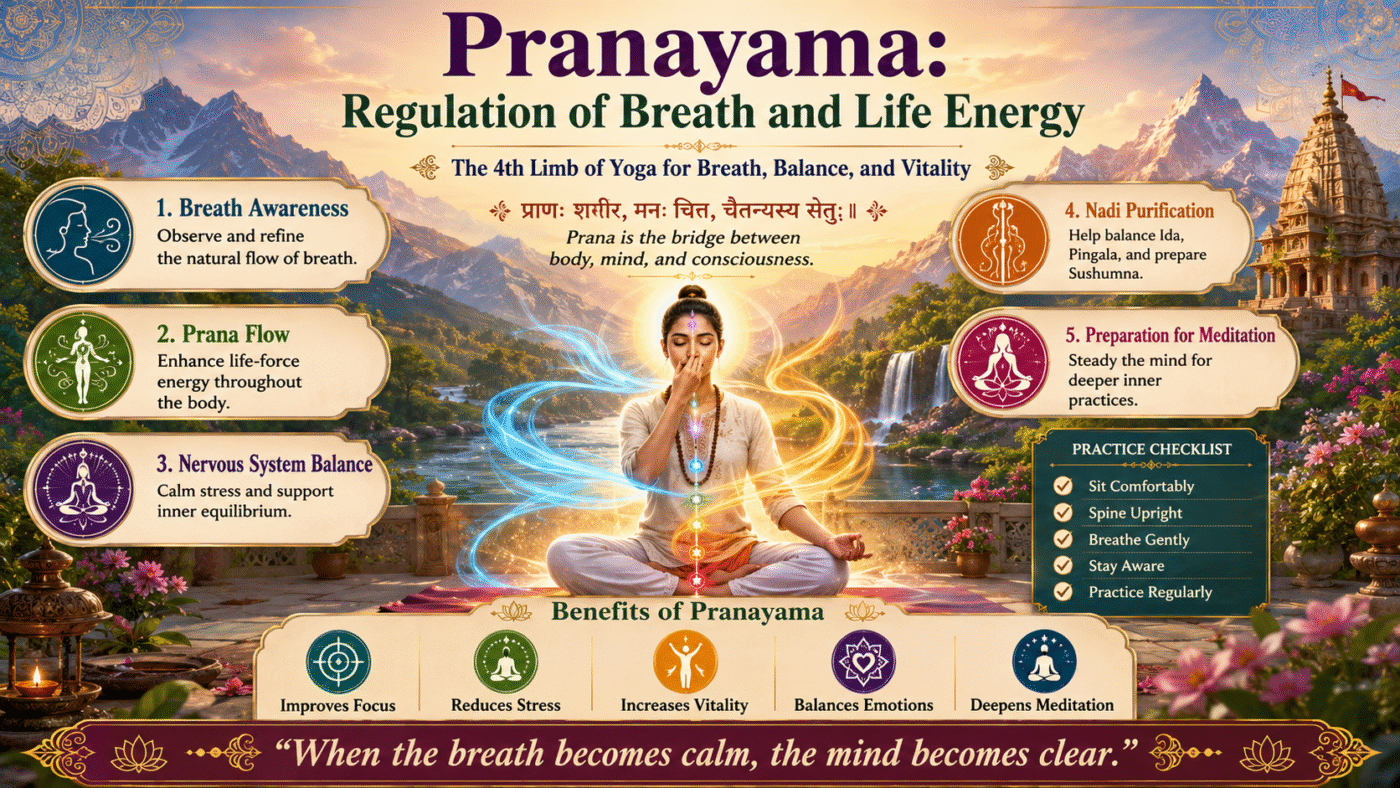
Pranayama is the fourth limb of yoga. Prana means life-force energy, and ayama means expansion or regulation. So Pranayama is the conscious regulation and expansion of prana through the breath.
Breath is deeply connected with the mind. When we are angry, breath becomes heated and fast. When anxious, breath becomes shallow. When peaceful, breath becomes slow and smooth. By regulating breath, we can influence the mind and nervous system.
In modern life, Pranayama is one of the most practical tools for stress management. Even a few minutes of slow breathing can reduce mental tension. Practices like Nadi Shodhana, Bhramari, Deep Yogic Breathing, and gentle Ujjayi can calm the mind, improve focus, balance emotions, and prepare for meditation.
Pranayama also has a deeper spiritual role. It purifies nadis, balances prana, and prepares the mind for inner practices. Without breath awareness, meditation often remains difficult because the mind keeps running.
However, Pranayama should be practiced carefully. Forceful practices like Kapalabhati, Bhastrika, and Kumbhaka should be learned under proper guidance. Breath is powerful, and wrong practice can disturb the system.
In modern life, conscious breathing is like a portable meditation tool. Wherever we are, the breath is with us.
5. Pratyahara: Withdrawal of the Senses
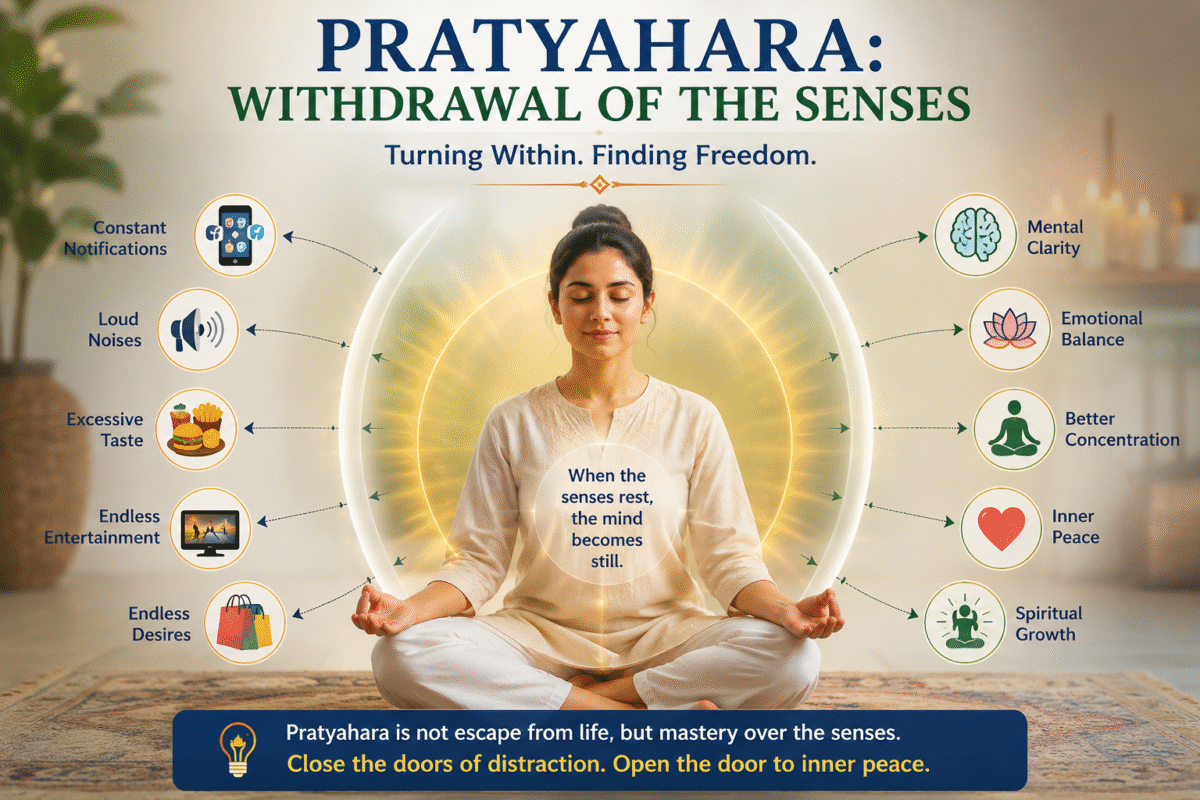
Pratyahara is the fifth limb of yoga. It means withdrawal of the senses from external distractions. This does not mean closing ourselves from life. It means gaining mastery over sensory pull.
Today, Pratyahara is more relevant than ever. Our senses are constantly overloaded by mobile phones, notifications, social media, advertisements, noise, news, entertainment, and endless information. The mind keeps moving outward. We check the phone again and again, even without need. We eat while watching screens. We work while thinking of messages. We rest while scrolling.
This constant outward movement makes the mind restless.
Pratyahara teaches us to pause. It teaches us to bring attention inward. It may begin with simple practices: keeping the phone away during meals, sitting quietly for a few minutes, closing the eyes after asana, observing breath, reducing unnecessary content, or spending time in silence.
When senses become disciplined, the mind becomes stronger. We no longer become slaves of every sound, image, taste, or desire.
Pratyahara is the bridge between outer yoga and inner yoga. Without it, deep concentration is difficult.
6. Dharana: Concentration
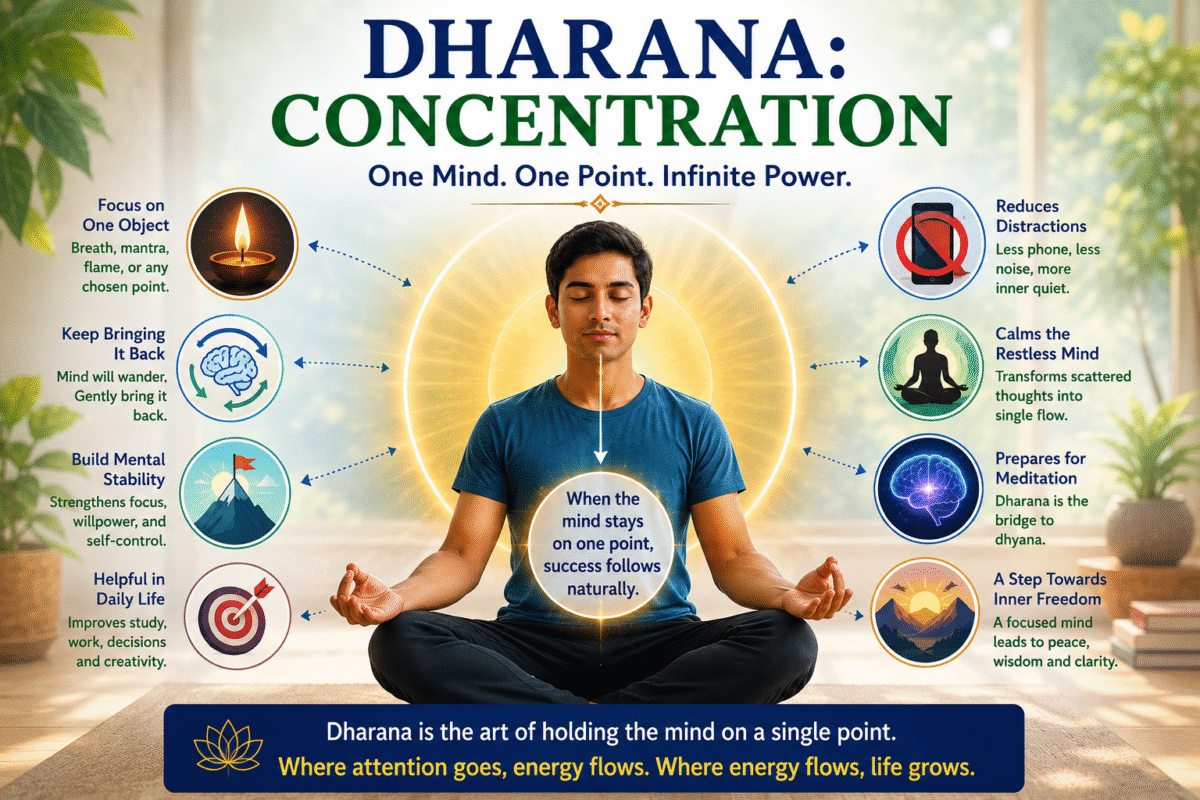
Dharana is the sixth limb of yoga. It means concentration, or holding the mind on one object. The object may be breath, mantra, chakra, light, sound, deity, or a point of awareness.
Modern people struggle deeply with concentration. The mind jumps from one thing to another. We start reading and then check the phone. We begin work and then open another tab. We sit for meditation and start planning the day.
Dharana trains the mind to stay. It teaches one-pointedness.
A simple Dharana practice is to focus on the breath at the nostrils. When the mind wanders, gently bring it back. Another practice is mantra repetition with awareness. Another is Trataka, candle gazing, where the eyes and mind focus on a flame.
Dharana is not easy in the beginning because the mind is used to wandering. But with regular practice, concentration improves. This helps not only in meditation but also in study, work, creativity, decision-making, and emotional control.
A concentrated mind is a powerful mind. A scattered mind wastes energy. Dharana gathers the energy of the mind.
7. Dhyana: Meditation
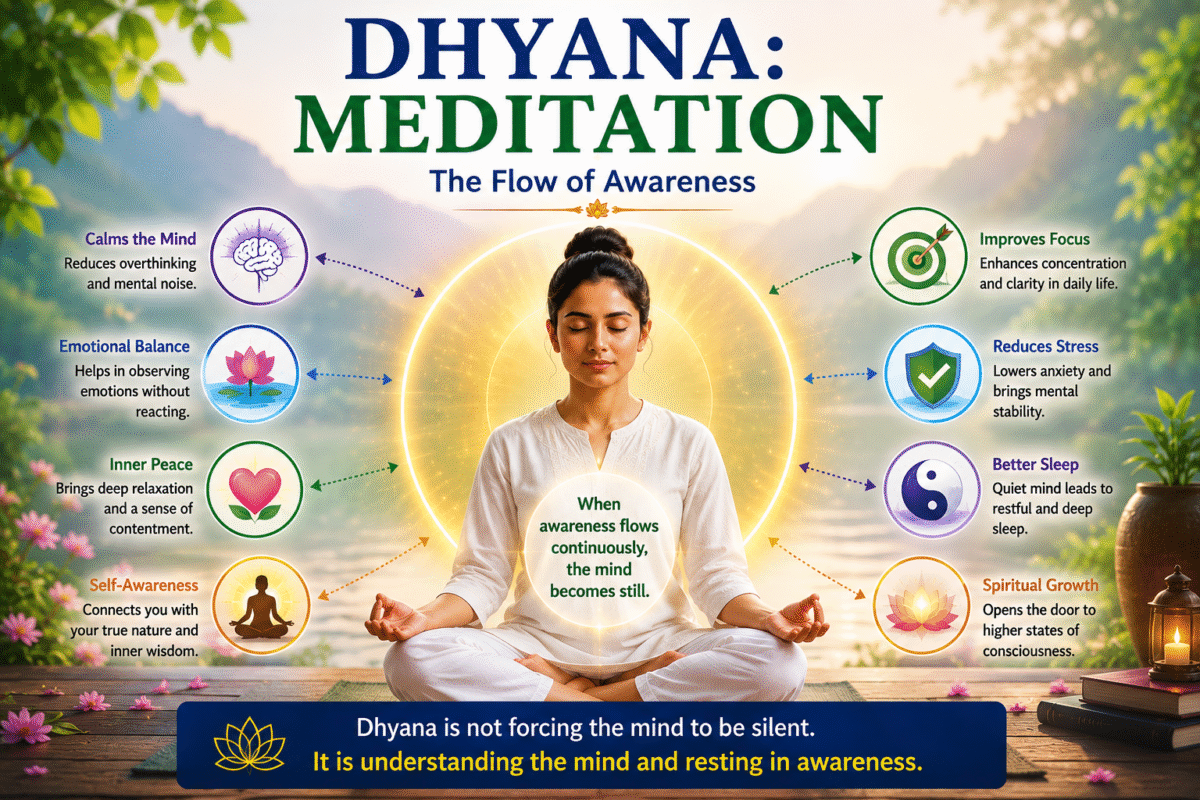
Dhyana is the seventh limb of yoga. It means meditation, the continuous flow of awareness toward the chosen object. Dharana is concentration with effort. Dhyana is deeper, smoother, and more continuous.
In meditation, the mind becomes quieter. Awareness becomes steady. The practitioner begins to observe thoughts, emotions, breath, body, and inner silence without being disturbed. Slowly, the sense of inner space opens.
Meditation is very important for modern life because most people are mentally overloaded. They may have physical comfort but no inner peace. Meditation helps reduce overthinking, stress, anxiety, emotional reactivity, and egoic restlessness.
But meditation is not only for relaxation. It is also for self-knowledge. Through meditation, we begin to see the nature of the mind. We notice desires, fears, attachments, memories, reactions, and ego patterns. This awareness becomes the beginning of transformation.
Meditation is also a doorway to spiritual wisdom. It helps us move from body-mind identification toward witness consciousness and deeper Self-awareness.
In modern life, even 10 to 20 minutes of daily meditation can bring great change if practiced sincerely.
8. Samadhi: Spiritual Absorption
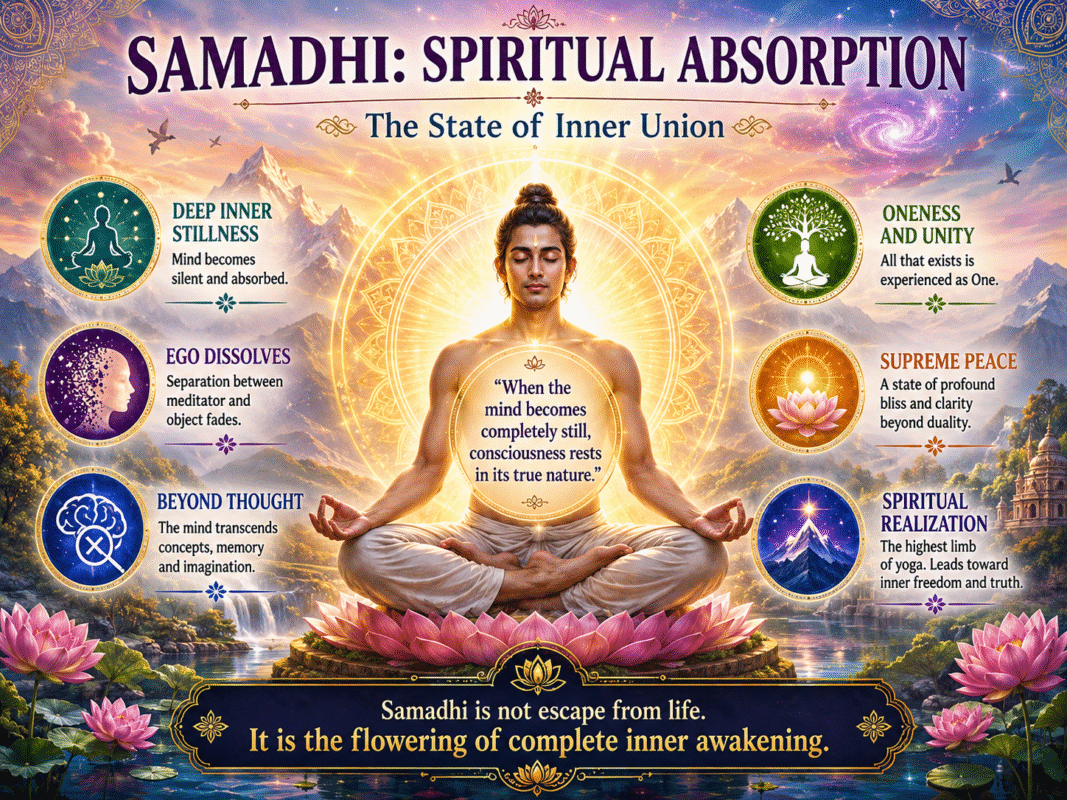
Samadhi is the eighth limb of yoga and the highest state of yogic practice. It is a state of deep absorption where the separation between meditator, meditation, and object begins to dissolve. The mind becomes silent, and consciousness rests in its own nature.
Samadhi cannot be forced. It arises when the earlier limbs mature. Ethical life purifies the heart. Discipline purifies lifestyle. Asana steadies the body. Pranayama steadies prana. Pratyahara withdraws the senses. Dharana focuses the mind. Dhyana deepens meditation. Then Samadhi becomes possible.
In modern language, Samadhi may be understood as a state of profound unity, silence, clarity, and spiritual absorption. But it should not be reduced to a temporary experience. Real Samadhi transforms life. It brings humility, peace, compassion, freedom from ego, and direct insight into the nature of reality.
Many seekers become fascinated by Samadhi, but Patanjali’s path reminds us that higher states require foundation. Without Yama and Niyama, spiritual experiences can become ego traps. Without discipline, they do not stabilize.
Samadhi is the flowering of the whole yogic path.
The 8 Limbs as a Complete Map for Modern Life
The beauty of the eight limbs is that they form a complete map. They do not reject daily life. They guide daily life.
Yama teaches us how to live with others.
Niyama teaches us how to live with ourselves.
Asana teaches us how to live in the body.
Pranayama teaches us how to live with breath and energy.
Pratyahara teaches us how to manage the senses.
Dharana teaches us how to focus.
Dhyana teaches us how to meditate.
Samadhi teaches us our highest spiritual possibility.
For a modern person, this path is extremely practical. It can improve relationships, health, emotional balance, work efficiency, mental peace, and spiritual depth.
How to Apply the 8 Limbs in Daily Life
You do not need to renounce everything to practice the eight limbs. Begin simply.
Practice Ahimsa by speaking more kindly. Practice Satya by being honest with yourself. Practice Aparigraha by reducing unnecessary buying.
Practice Shaucha by keeping your body and surroundings clean. Practice Santosha by writing three things you are grateful for. Practice Tapas by maintaining regular yoga practice.
Practice Asana for 20 to 30 minutes daily. Practice Pranayama for 5 to 10 minutes. Practice Pratyahara by keeping the phone away for some time. Practice Dharana by focusing on one task at a time. Practice Dhyana by sitting silently every day. Practice surrender by offering the fruits of your actions to the Divine.
Small daily steps create deep transformation.
Learn Yoga with Adwait Yoga School
Those who wish to learn yoga systematically can explore the Yoga Teacher Training Courses offered by Adwait Yoga School.
Adwait Yoga School offers Yoga Teacher Training Courses in 50 hour, 100 hour, 200 hour, 300 hour, and 500 hour formats. The school’s Yoga Teacher Training page describes the 200-hour Yoga Teacher Training Course as a graduate-level course that includes beginner, intermediate, and some advanced levels of Asanas, Pranayama, Bandha, Mudra, Kriya, Meditation, and other components of Yoga. The 300-hour course is described as a master’s-level course with intermediate and advanced levels of yogic practices. (adwaityoga.com)
You can visit the Yoga Teacher Training Course page here:
Learning through a structured Yoga Teacher Training Course helps students understand yoga not only as physical practice but as a complete system of lifestyle, philosophy, anatomy, pranayama, meditation, discipline, teaching methodology, and spiritual growth. Adwait Yoga School also describes itself as offering Yoga Teacher Training Courses, Pranayama Teacher Training Courses, Meditation Teacher Training Courses, yoga classes, workshops, retreats, and other yoga programs to worldwide students. (adwaityoga.com)
Final Thoughts
The eight limbs of yoga are not outdated teachings. They are a timeless guide for modern life. In a world full of distraction, stress, speed, comparison, and confusion, Patanjali’s path gives clarity.
Yama teaches ethical living. Niyama teaches personal discipline. Asana prepares the body. Pranayama balances breath and energy. Pratyahara protects the mind from sensory overload. Dharana strengthens concentration. Dhyana deepens meditation. Samadhi reveals the highest possibility of consciousness.
Yoga is not only what we do on the mat. Yoga is how we speak, eat, work, think, breathe, love, serve, and respond to life. It is a journey from restlessness to stillness, from ego to awareness, from confusion to clarity, and from separation to union.
If we practice even a little every day with sincerity, the eight limbs can slowly transform our whole life.
Modern life does not need less yoga. It needs deeper yoga.
Not only posture, but awareness.
Not only flexibility, but discipline.
Not only relaxation, but realization.
This is the true gift of the eight limbs of yoga.