
Overthinking has become one of the most common mental problems of modern life. Many people are physically present in one place, but mentally they are living in ten different places at the same time. The mind keeps thinking about the past, worrying about the future, imagining problems, replaying conversations, comparing, judging, and creating unnecessary mental pressure.
Sometimes we know that we are overthinking, but still we cannot stop it. We say, “I know I should not think so much, but my mind does not listen.” This is because overthinking is not only a mental habit. It is also connected with breath, nervous system, emotions, body tension, and pranic imbalance.
In Yoga, breath has always been understood as the bridge between body and mind. When the breath is disturbed, the mind becomes disturbed. When the breath becomes calm, the mind slowly begins to calm down. This is the foundation of Pranayama.
So, can your breath control overthinking?
The answer is yes — but not through force. Breath can help regulate overthinking naturally when it is practiced with awareness, gentleness, and regularity. Breath does not remove all thoughts like magic, but it gives the mind a new rhythm, calms the nervous system, balances prana, and creates inner space between awareness and thoughts.
This is why Pranayama is one of the most practical yogic tools for people who suffer from overthinking, anxiety, mental tiredness, and lack of focus.
What Is Overthinking?
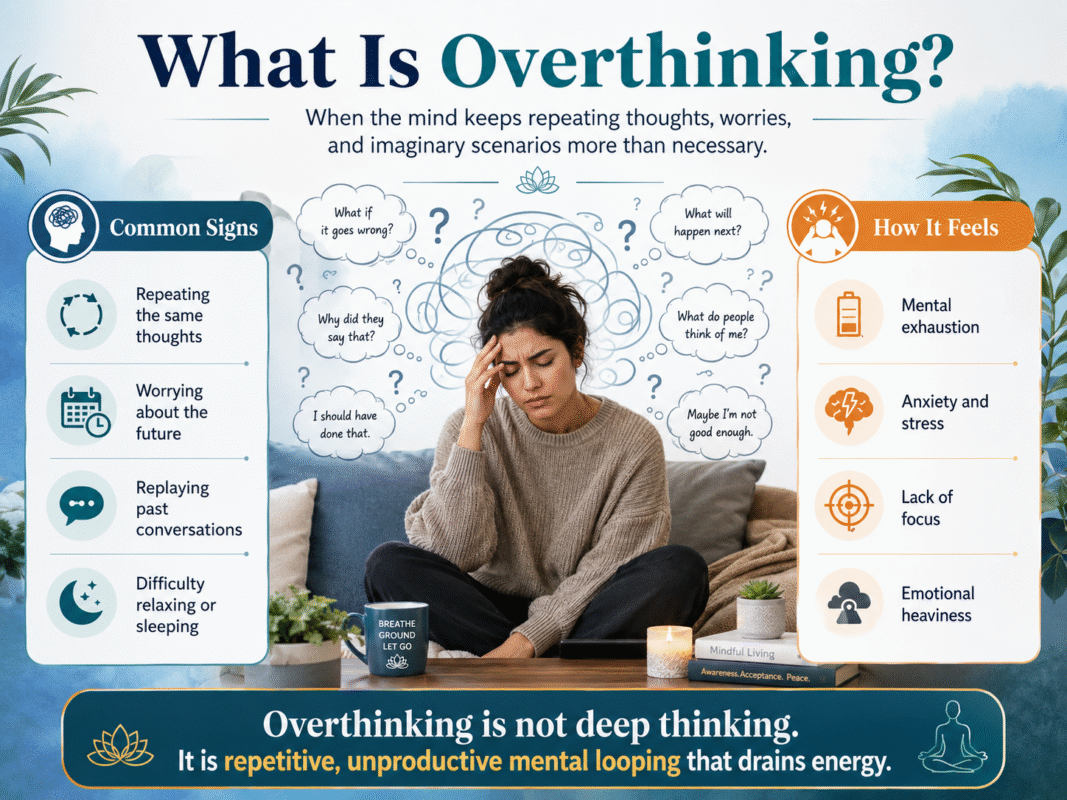
Overthinking means thinking more than necessary, especially in a repetitive, uncontrolled, and unproductive way. It is not the same as deep thinking. Deep thinking brings clarity. Overthinking creates confusion.
Deep thinking helps us solve problems. Overthinking keeps repeating the problem.
Deep thinking is focused. Overthinking is scattered.
Deep thinking ends in understanding. Overthinking often ends in stress.
For example, if you have an important decision to make, thinking carefully is useful. But if the mind keeps repeating the same fear again and again — “What if I fail? What if people judge me? What if I make the wrong choice?” — then it becomes overthinking.
Overthinking often includes:
Worrying about the future
Regretting the past
Replaying old conversations
Imagining negative outcomes
Constant self-doubt
Fear of making mistakes
Comparing yourself with others
Analyzing every small situation
Difficulty sleeping because of thoughts
Feeling mentally tired even without physical work
Overthinking drains mental energy. It makes simple things feel heavy. It disturbs sleep, digestion, mood, focus, and inner peace.
Why Does the Mind Overthink?
The mind overthinks for many reasons. Sometimes it is trying to protect us. It thinks again and again because it wants certainty, safety, and control. But life is not always certain. So the mind keeps searching, but does not find final satisfaction.
Overthinking may happen due to stress, anxiety, fear, insecurity, emotional wounds, perfectionism, lack of trust, excessive responsibilities, or constant digital stimulation.
When the nervous system is tense, the mind becomes alert. It keeps scanning for problems. Even small things feel big. This is why overthinking often increases at night, during silence, or after emotional situations.
From a yogic view, overthinking happens when prana is disturbed and the mind is full of vrittis, or mental fluctuations. The mind moves continuously because energy is moving irregularly. Breath becomes shallow, fast, or uneven. The body becomes tense. The thoughts become repetitive.
So if we want to calm overthinking, we should not only fight thoughts. We should also calm the breath and nervous system.
The Relationship Between Breath and Mind
Breath and mind are deeply connected. Observe your breath in different emotional states.
When you are angry, the breath becomes fast and hot.
When you are anxious, the breath becomes shallow and irregular.
When you are sad, the breath becomes heavy.
When you are relaxed, the breath becomes slow and smooth.
This shows that the mind affects the breath. But Yoga teaches the reverse also: by changing the breath, we can influence the mind.
This is a very important point.
If you try to control thoughts directly, you may struggle. The mind may resist. But if you gently regulate the breath, the mind receives a signal of safety. Slowly, mental speed reduces.
In simple words, breath is the doorway to the mind.
This is why in Yoga, meditation does not usually begin by attacking thoughts. It begins with posture, breath, awareness, and relaxation. When the breath becomes steady, the mind becomes ready.
The Yogic Science of Pranayama
Pranayama is the yogic practice of regulating and expanding prana through breath. The word Pranayama comes from Prana and Ayama. Prana means life-force energy, and Ayama means expansion, regulation, or extension.
Pranayama is not merely breathing exercise. It works on physical, mental, emotional, energetic, and spiritual levels. It improves breath awareness, balances prana, steadies the nervous system, and prepares the mind for meditation.
In the yogic tradition, the mind and prana move together. When prana is restless, the mind is restless. When prana becomes balanced, the mind becomes balanced. Therefore, Pranayama is one of the most effective ways to reduce mental turbulence.
Overthinking is like a storm of mental waves. Pranayama does not fight each wave separately. It calms the wind that creates the waves.
Breath and the Nervous System
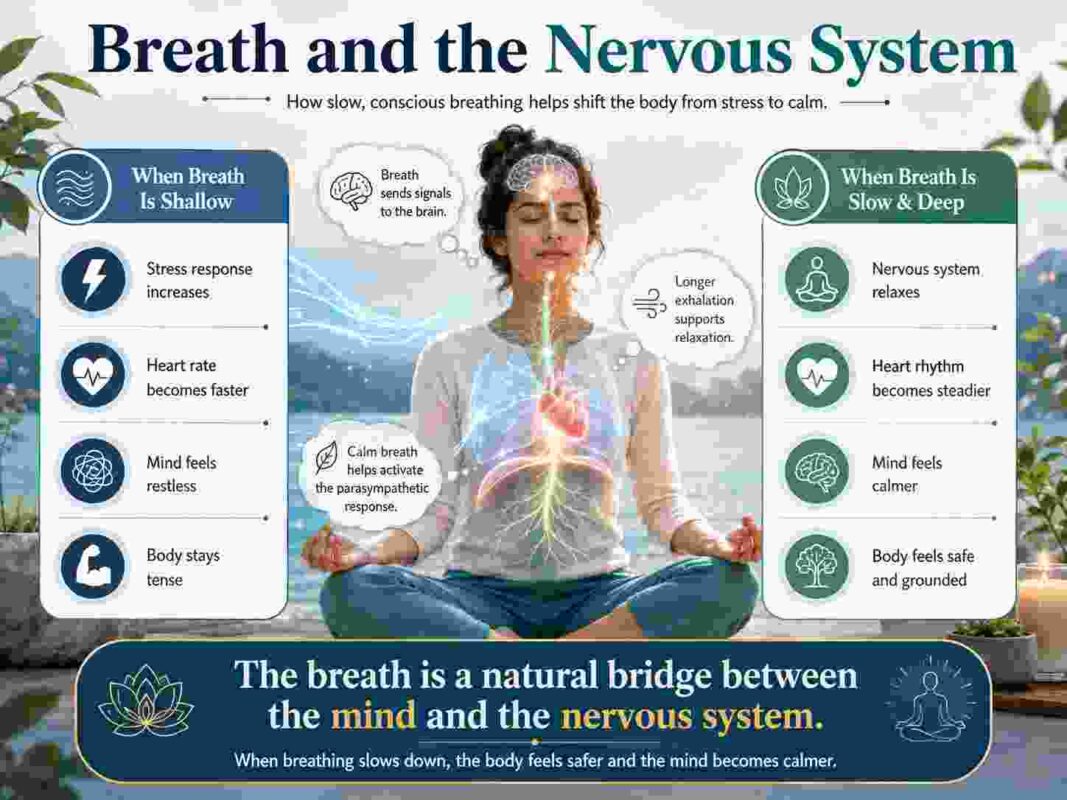
Modern science also supports the importance of breath. Breathing is connected with the autonomic nervous system, which controls many automatic functions like heart rate, digestion, stress response, and relaxation.
When we are stressed, the sympathetic nervous system becomes active. This is known as fight-or-flight mode. In this state, breathing becomes faster, heart rate increases, muscles tighten, and the mind becomes alert. Overthinking often becomes stronger in this state.
Slow breathing, especially with a longer exhalation, activates the parasympathetic nervous system, which is connected with rest, digestion, recovery, and calmness. The body receives a message: “I am safe.”
When the body feels safe, the mind does not need to keep scanning for danger. Thoughts become slower. Emotional reactions reduce. Focus improves.
This is why breathwork is now widely used in stress management, therapy, mindfulness, meditation, and yoga therapy.
Can Breath Stop Thoughts Completely?
This is an important question. Many people think that if Pranayama works, then all thoughts should stop immediately. This expectation itself creates frustration.
Breath does not always stop thoughts completely, especially in the beginning. But it changes your relationship with thoughts.
When you breathe consciously, you are no longer fully lost in thinking. Part of your attention is with the breath. This creates a gap. In that gap, awareness becomes stronger.
Over time, the mind learns to slow down. Thoughts may still arise, but they do not control you as much. You can observe them, let them pass, and return to the breath.
The goal is not to violently suppress thoughts. Suppressed thoughts return with more force. The goal is to calm the system so that thoughts naturally lose their intensity.
Breath Awareness: The First Step
The simplest practice for overthinking is breath awareness. You do not need any complicated technique. Just sit comfortably, close the eyes, and observe the natural breath.
Feel the breath entering through the nostrils. Feel the breath leaving. Notice whether the breath is long or short, deep or shallow, smooth or rough. Do not judge it. Do not force it. Just observe.
When thoughts come, notice them and return to the breath.
This practice may look very simple, but it is powerful. It teaches the mind to come back to the present moment. Overthinking lives in past and future. Breath lives in the present. So when attention returns to breath, it returns to now.
Practice this for 5 minutes daily. Slowly increase to 10 or 15 minutes.
Diaphragmatic Breathing for Mental Calm
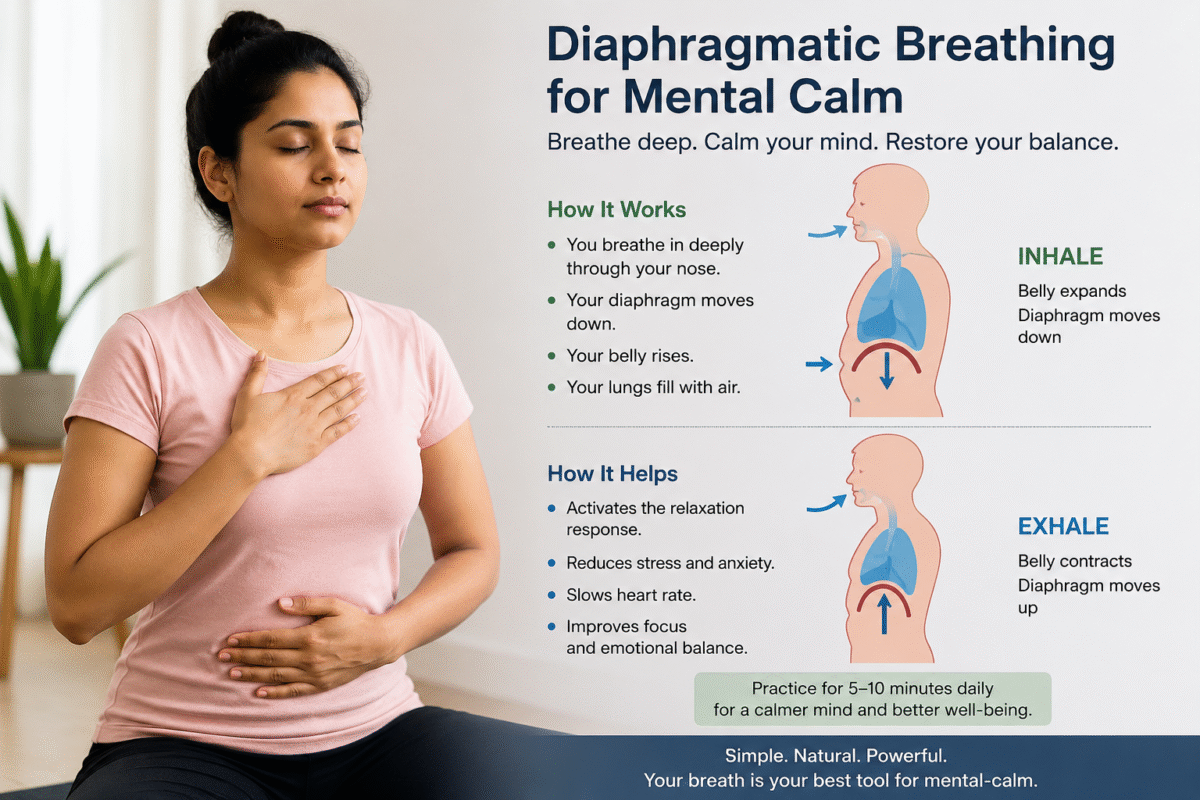
Many people who overthink also breathe from the upper chest. This kind of breathing can keep the body in a mild stress state. Diaphragmatic breathing, or belly breathing, helps calm the body and mind.
To practice, sit or lie down comfortably. Place one hand on the abdomen and one hand on the chest. Inhale gently and allow the abdomen to expand. Exhale slowly and allow the abdomen to soften.
Do not push the belly forcefully. Let the breath be natural and smooth.
Practice for 5 minutes.
This breathing helps ground the mind. It brings awareness into the body. It reduces mental speed. It is especially useful when thoughts are racing.
Longer Exhalation to Reduce Overthinking
Longer exhalation is one of the best breathing methods for calming the nervous system. Inhalation is slightly energizing, while exhalation is relaxing. When the exhalation becomes longer, the body begins to release tension.
A simple practice is:
Inhale for 4 counts.
Exhale for 6 counts.
If 4 and 6 feel difficult, practice 3 and 5. The ratio should be comfortable. Never strain the breath.
Practice for 3 to 5 minutes when overthinking becomes strong.
This practice is very useful before sleep, before difficult conversations, after work, or during anxiety.
The longer exhalation tells the mind: “Slow down. There is no immediate danger.”
Nadi Shodhana for Balance
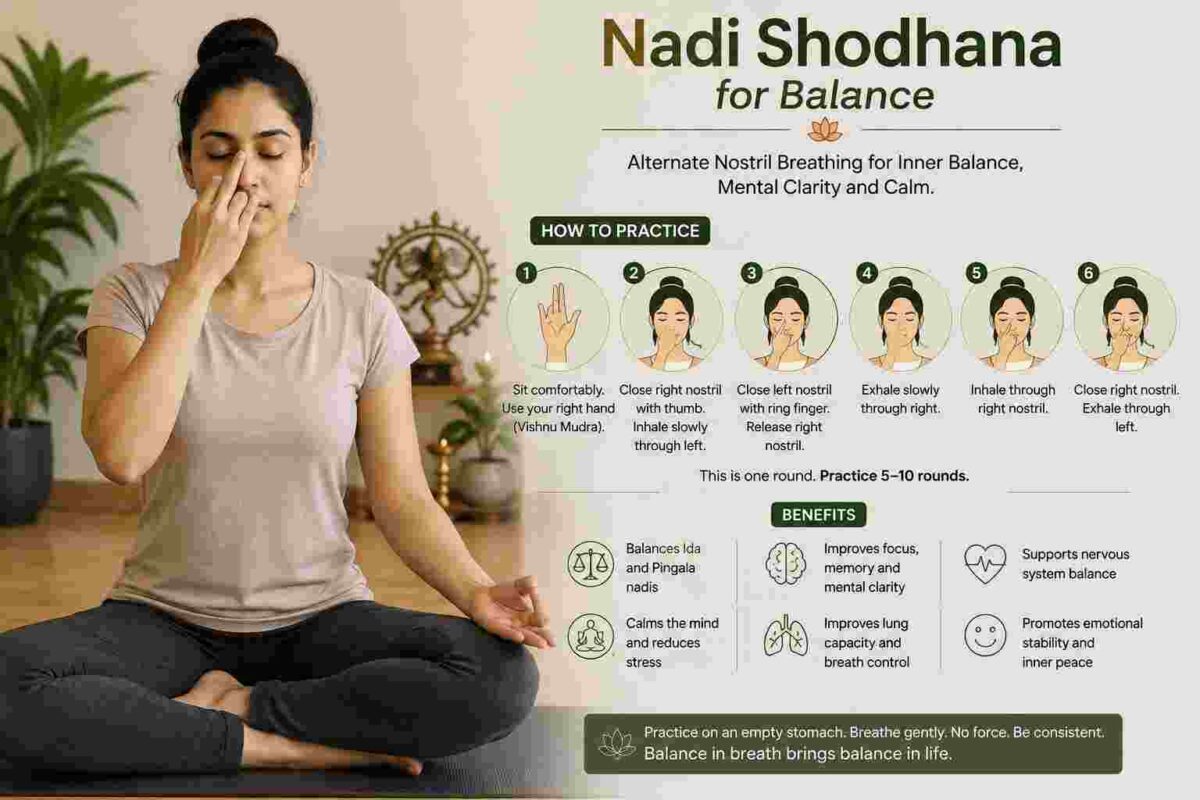
Nadi Shodhana, or alternate nostril breathing, is one of the most important Pranayama practices for mental balance. In Yoga, it is said to purify the nadis and balance Ida and Pingala.
Ida represents cooling, calming, lunar energy. Pingala represents heating, active, solar energy. When these energies are imbalanced, the mind may become restless, dull, emotional, or overstimulated. Nadi Shodhana brings harmony.
To practice, sit comfortably. Close the right nostril and inhale through the left. Close the left nostril and exhale through the right. Inhale through the right. Close the right and exhale through the left. This completes one round.
Practice 5 to 10 rounds slowly.
For beginners, do not add breath retention. Keep it gentle.
Nadi Shodhana is excellent for overthinking because it gives the mind a clear rhythm and balanced focus.
Bhramari Pranayama for Mental Noise
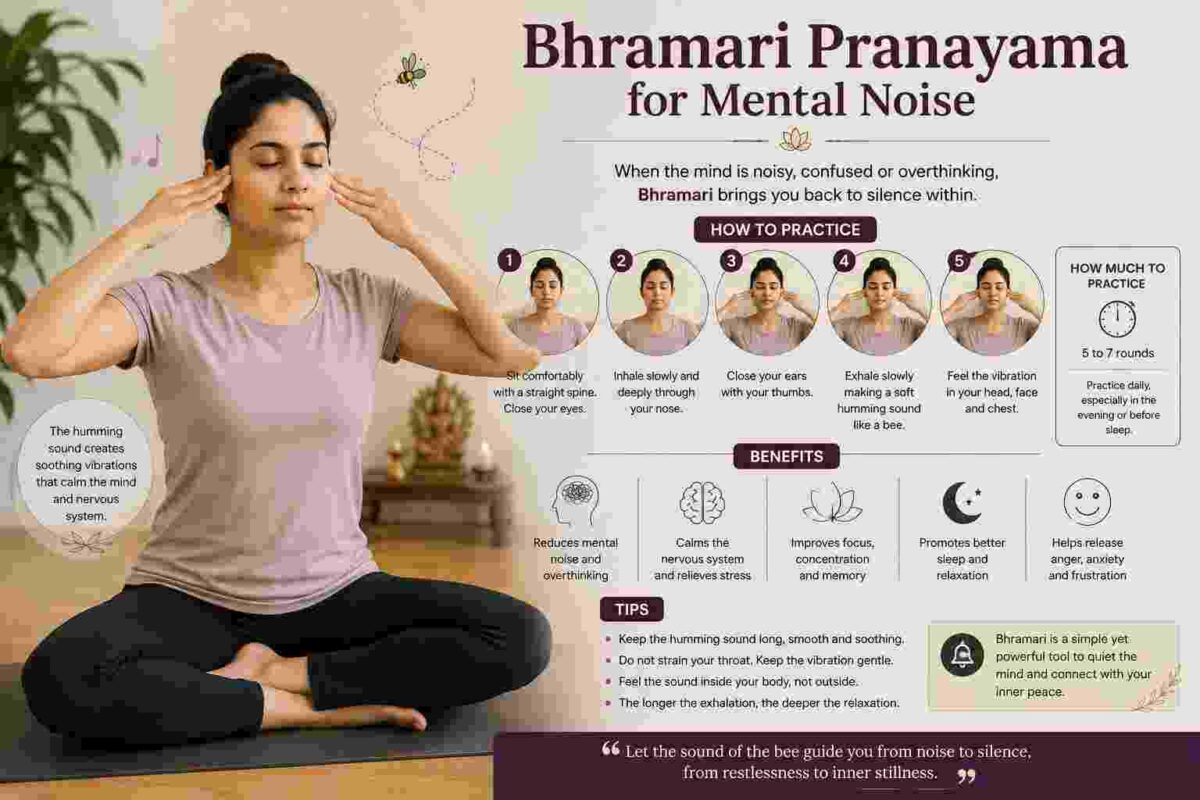
Bhramari Pranayama, or humming bee breath, is very helpful when the mind is noisy. The humming sound creates a soothing vibration in the head, face, throat, and chest. It naturally draws attention inward and reduces mental agitation.
To practice, sit comfortably. Inhale gently through the nose. Exhale with a soft humming sound like a bee. Feel the vibration. Keep the sound smooth and relaxing.
Practice 5 to 7 rounds.
Bhramari is especially helpful for people who feel pressure in the mind, emotional stress, anger, anxiety, or sleeplessness due to overthinking.
The vibration gives the mind something peaceful to follow. Slowly, mental noise reduces.
Ujjayi Breath for Focus
Ujjayi Pranayama is practiced by slightly narrowing the throat and breathing with a soft ocean-like sound. It brings attention inward and creates a steady rhythm.
For overthinking, gentle Ujjayi can help because the sound of the breath becomes an anchor. The mind follows the breath instead of running into thoughts.
Sit comfortably. Breathe through the nose. Slightly contract the throat as if whispering softly from inside. Let the breath become smooth and audible to you. Do not make it harsh.
Practice for 3 to 5 minutes.
Ujjayi should be gentle. If the throat feels tight or the head feels heavy, stop and return to natural breathing.
Om Chanting and Overthinking
Sound and breath together are powerful for calming the mind. Om chanting is one of the simplest and most sacred practices. When you chant Om, the exhalation becomes longer, and the vibration spreads through the body.
To practice, inhale gently and chant Om slowly. Let the sound be smooth. Feel the vibration in the chest, throat, and head. After the sound ends, sit for a moment in silence.
Practice 9 times.
Om chanting helps reduce overthinking because it combines breath, sound, vibration, devotion, and awareness. It gives the restless mind a sacred direction.
Why Forceful Breathing May Not Help
Some people try strong breathing techniques when they are already anxious or mentally tired. They may practice forceful Kapalabhati, Bhastrika, or intense breath retention. These practices have value in Yoga, but they are not suitable for everyone at all times.
If the mind is already overactive, forceful breathing can sometimes increase agitation, heat, dizziness, or anxiety.
For overthinking, gentle breathing is usually better. Slow breath. Soft breath. Longer exhalation. Nadi Shodhana. Bhramari. Natural awareness.
The goal is not to defeat the mind. The goal is to soothe it.
Breath as an Anchor in Daily Life
You do not need to wait for formal practice to use breath. Breath can help throughout the day.
Before replying to a stressful message, take three conscious breaths.
Before entering a meeting, take five slow breaths.
When stuck in traffic, observe the breath instead of reacting.
Before eating, take a few calm breaths.
Before sleeping, exhale slowly and release the day.
Whenever overthinking starts, pause and return to breath.
These small pauses can change your whole day. They prevent the mind from going too far into unnecessary stories.
Breath and Mindfulness
Breath awareness is also the foundation of mindfulness. Mindfulness means present-moment awareness. When we observe the breath, we are practicing mindfulness.
Overthinking pulls us away from the present. Mindfulness brings us back.
A mindful breath is not just air entering and leaving. It is a moment of returning. Returning from imagination to reality. Returning from fear to presence. Returning from mental noise to inner clarity.
Even one mindful breath can break the chain of unconscious thinking.
Breath and Sleep
Overthinking often becomes worse at night. During the day, we remain busy, but at night the mind starts replaying everything. This disturbs sleep.
A simple breathing routine before sleep can help.
Lie down comfortably. Place one hand on the abdomen. Inhale naturally. Exhale slowly. Let every exhalation release tension. If useful, count the breath: inhale 4, exhale 6. Continue for 5 to 10 minutes.
You can also practice Bhramari softly before lying down.
Do not try to force sleep. Just relax the body and observe the breath. Sleep comes more easily when the nervous system becomes calm.
Breath, Emotions, and Overthinking
Many times, overthinking is not really about thoughts. It is about emotions. The mind thinks too much because it is trying to avoid feeling something.
For example, after someone speaks harshly, the mind may keep replaying the conversation. But underneath, there may be hurt. After a mistake, the mind may keep analyzing. But underneath, there may be shame or fear.
Breath helps us feel emotions safely. When we breathe consciously, we can stay present with the body. We can feel the emotion without being swallowed by it.
Instead of thinking about sadness, we can feel sadness with breath.
Instead of thinking about fear, we can feel fear with breath.
This is healing.
Breath and Prana
In Yoga, breath controls overthinking because breath regulates prana. Thoughts are not separate from energy. When prana is scattered, thoughts are scattered. When prana becomes centered, thoughts become quieter.
Pranayama gathers the energy of the mind. It brings the senses inward. It prepares for concentration and meditation.
This is why Pranayama is placed before deeper practices like Pratyahara, Dharana, and Dhyana. First breath becomes steady. Then senses withdraw. Then mind concentrates. Then meditation deepens.
If you want to control overthinking, do not begin with mental force. Begin with prana. Begin with breath.
A Simple 10-Minute Breathing Routine for Overthinking
Here is a simple routine you can practice daily.
First, sit comfortably and observe natural breath for 1 minute.
Then practice diaphragmatic breathing for 3 minutes.
Next, practice longer exhalation breathing for 3 minutes. Inhale for 4 counts and exhale for 6 counts.
Then practice Bhramari for 5 rounds.
Finally, sit silently for 2 minutes and feel the effect.
This short routine can be practiced in the morning, evening, or before sleep. The key is regularity.
A calm mind is not created in one day. It is trained through daily practice.
Learn Pranayama with Adwait Yoga School
Those who want to learn Pranayama deeply and systematically can explore the Pranayama Teacher Training Course offered by Adwait Yoga School.
Adwait Yoga School offers Pranayama Teacher Training Courses for students, yoga practitioners, teachers, healers, and spiritual seekers who want to understand breathwork from both practical and traditional yogic perspectives. Through structured training, students can learn different Pranayama techniques, breath awareness, pranic science, safety guidelines, practice sequencing, and teaching methodology.
You can visit the Pranayama Teacher Training Course page here:
Learning Pranayama under proper guidance is very important because breath is powerful. Gentle breathing can calm the mind, but wrong or forceful practice may disturb the nervous system. A structured course helps students understand how to practice safely, gradually, and effectively.
Final Thoughts
Yes, your breath can control overthinking — not by force, but by regulation, awareness, and inner balance.
Overthinking is often a sign that the mind is restless, the nervous system is tense, and prana is scattered. Breath gives us a direct way to influence all three.
When you observe the breath, you return to the present.
When you slow the breath, the nervous system relaxes.
When you lengthen the exhalation, the body releases tension.
When you practice Nadi Shodhana, prana becomes balanced.
When you practice Bhramari, mental noise becomes softer.
When you chant Om, the mind receives sacred rhythm.
The mind cannot be beaten into silence. It must be guided gently. Breath is that gentle guide.
So whenever overthinking becomes strong, pause. Sit quietly. Breathe slowly. Feel the body. Watch the breath. Let thoughts come and go. Return again and again.
Slowly, you will discover that you are not helpless before your thoughts. You have a natural tool within you.
That tool is your breath.
And through the breath, the doorway to calmness, clarity, and inner freedom is always open.