Karma is one of the most powerful and misunderstood concepts of Indian spiritual wisdom. Many people use the word karma casually. If something good happens, they say, “Good karma.” If something bad happens, they say, “Bad karma.” Some people think karma means fate. Some think it means punishment. Some think it means that whatever is happening in life is fixed and cannot be changed. But this is not the complete understanding of karma.
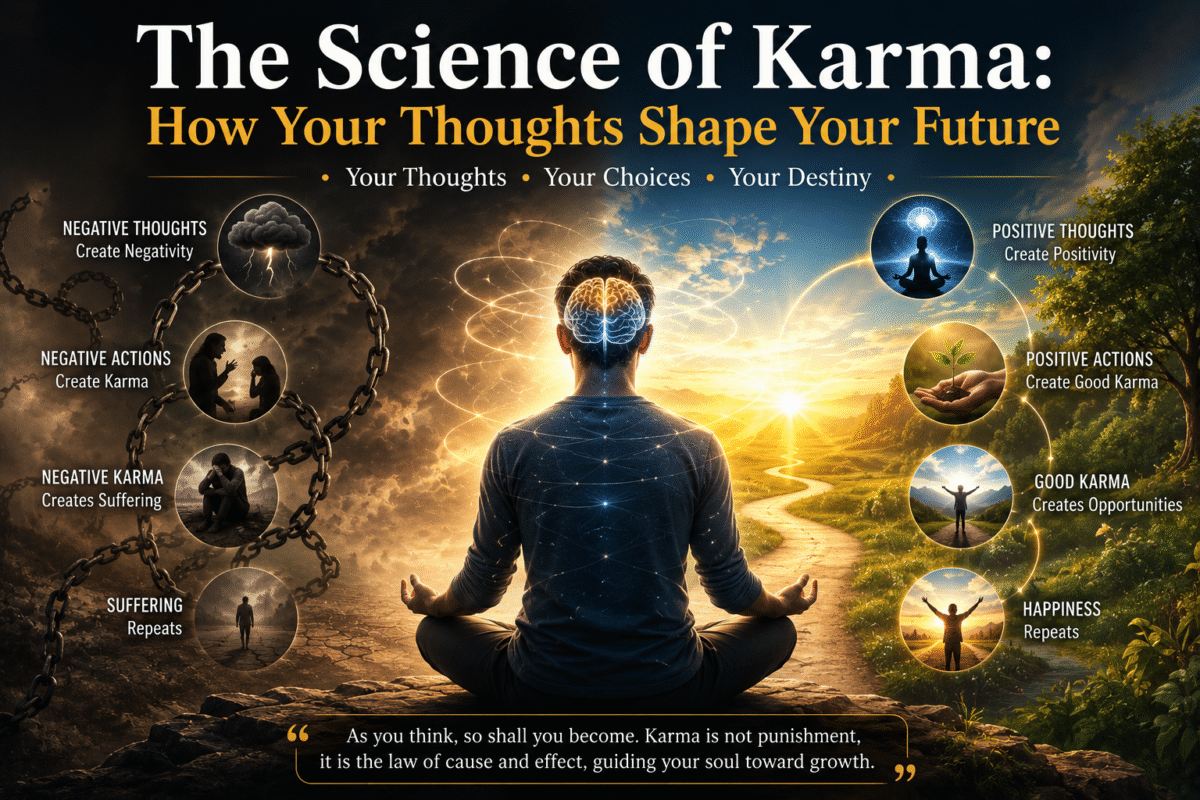
In the deeper Indian yogic and spiritual tradition, karma means action, but action is not only physical. Thought is also action. Intention is also action. Speech is also action. Repeated emotion is also action. Every movement of body, speech, and mind creates an impression. These impressions slowly shape our personality, habits, choices, relationships, and future experiences.
This is why karma is not merely a religious belief. It is also a psychological, ethical, and spiritual law. The thoughts we repeatedly think become patterns. The patterns become habits. Habits become character. Character influences destiny. In this way, our inner world quietly shapes our outer future.
Modern psychology and neuroscience also say something similar in their own language. Repeated thoughts strengthen neural pathways. Repeated emotions condition the nervous system. Repeated behaviour forms habits. Repeated habits shape life direction. This is very close to the traditional understanding of samskara, or mental impressions.
So when we ask, “How do your thoughts shape your future?” the answer is simple but deep: your thoughts are not small things. They are seeds. When nourished again and again, they become your actions, your attitude, your decisions, your relationships, and your life path.
What is Karma?
The Sanskrit word “karma” means action. But in Indian wisdom, action does not refer only to what we do physically. Karma includes the intention behind the action. Two people may perform the same outer action, but their karma may be different because their intention is different.
For example, one person gives charity to genuinely help someone. Another person gives charity only to show status and gain praise. The physical act may look the same, but the inner karma is different. Karma is deeply connected with intention, awareness, and consciousness.
The Bhagavad Gita teaches that action is unavoidable. As long as we live, we act. Even not acting is a form of action when it comes from fear, laziness, or avoidance. Therefore, the question is not whether we should act or not. The real question is: from what state of mind are we acting?
If action comes from greed, anger, ego, fear, jealousy, hatred, or ignorance, it creates inner bondage. If action comes from clarity, compassion, wisdom, duty, self-discipline, and surrender, it creates purification and growth.
This is the science of karma.
Thoughts as Subtle Karma
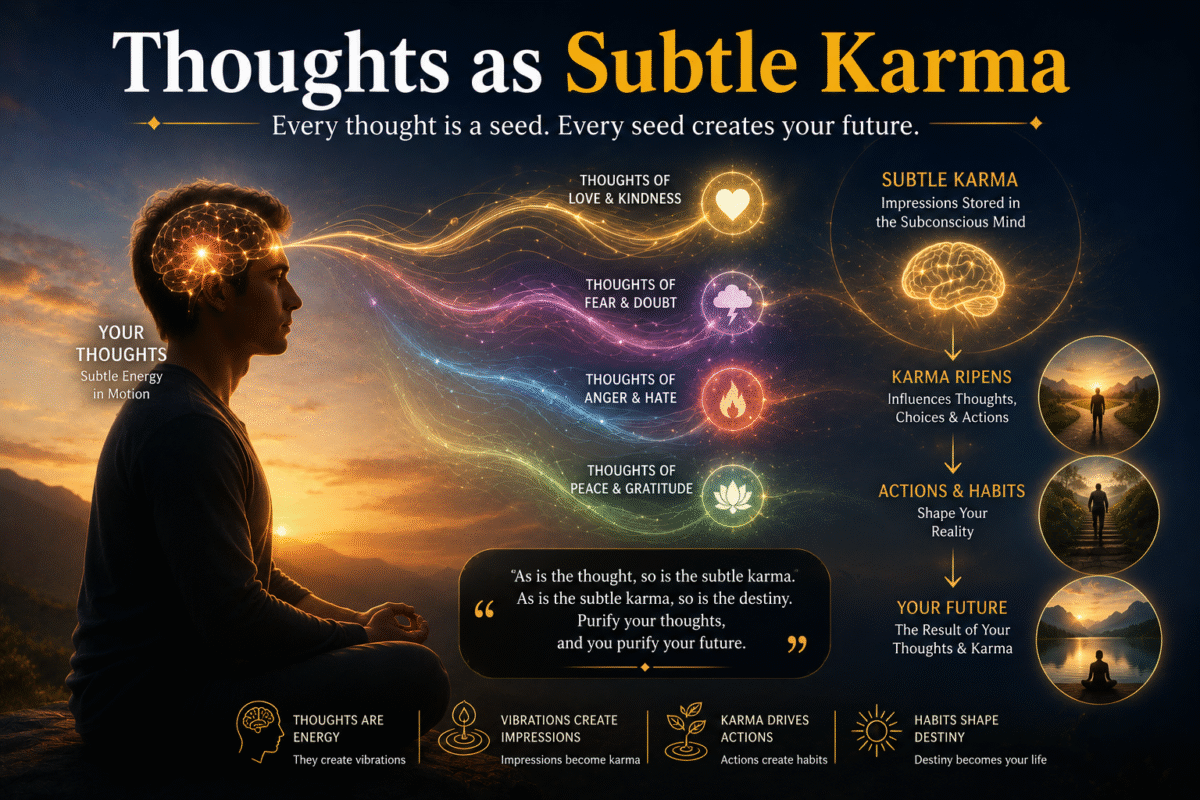
Many people understand karma only as physical action, but Indian traditions go deeper. Thought itself is subtle karma. Every thought leaves a subtle impression on the mind. If a thought comes once and goes, it may not have much strength. But when the same kind of thought is repeated again and again, it becomes a pattern.
If a person repeatedly thinks, “I am weak,” slowly the mind begins to believe it. The body language changes. Confidence reduces. Opportunities are avoided. The person may not even try fully. In this way, one thought becomes a future limitation.
If another person repeatedly thinks, “I can learn, I can improve, I can grow,” then courage increases. Effort increases. Learning improves. Failures become lessons. Slowly, life direction changes.
This does not mean that positive thinking alone can solve everything. Life is complex. Karma also includes environment, past actions, family conditioning, society, health, and circumstances. But our present thoughts still play a very powerful role in shaping our response and future direction.
Thought is the seed. Action is the plant. Character is the tree. Destiny is the fruit.
The Yogic View: Samskara and Vasana
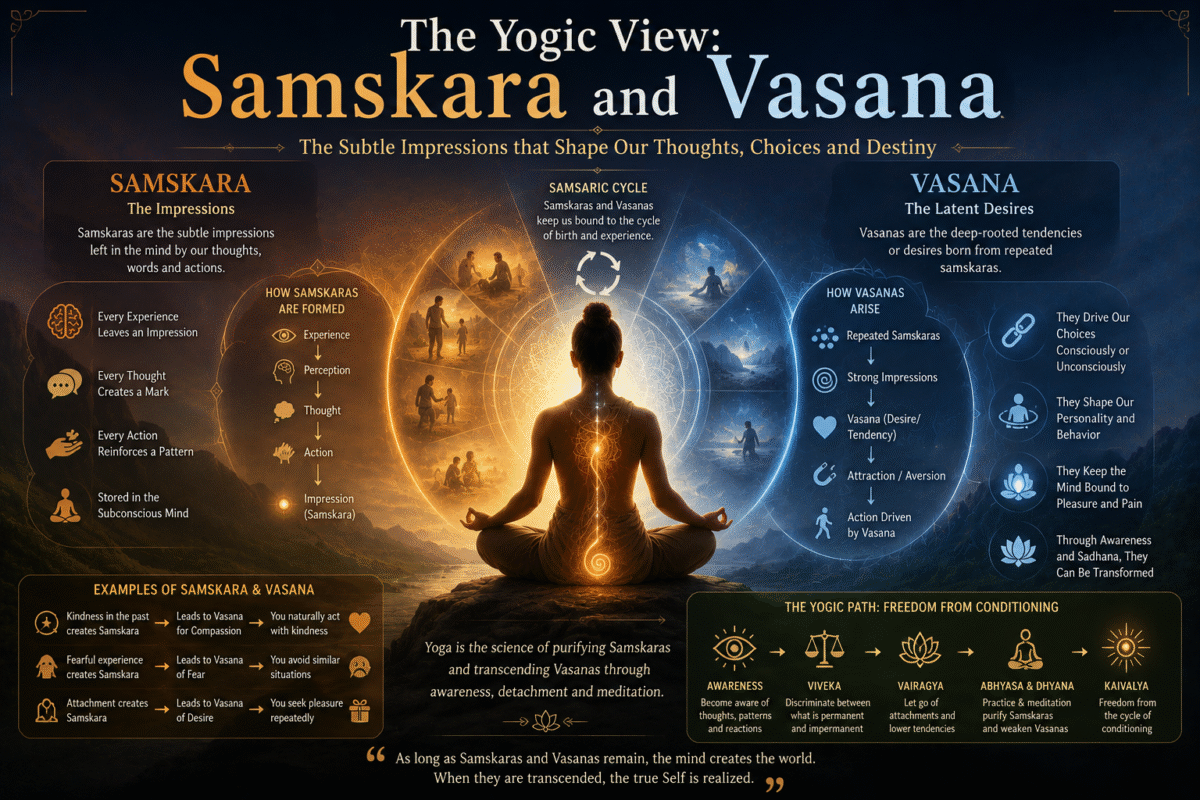
In Yoga and Vedanta, repeated thoughts and actions create samskaras. Samskara means impression or mental imprint. These impressions stay in the deeper layers of the mind and influence future thoughts, emotions, and behaviour.
For example, if someone repeatedly reacts with anger, an anger samskara becomes strong. Next time a small trigger comes, anger arises quickly. If someone repeatedly practices patience, a patience samskara becomes strong. Next time difficulty comes, the person can remain more balanced.
Vasana means deep tendency or latent desire. Samskaras and vasanas together shape our personality. They decide what attracts us, what disturbs us, what we fear, what we repeat, and how we respond to life.
This is why spiritual practice is so important. Yoga, meditation, mindfulness, mantra, self-study, discipline, and ethical living help purify old samskaras and create new sattvic impressions.
The mind is like a field. Whatever seeds we keep planting will grow. If we plant fear, anger, and greed, those plants will grow. If we plant awareness, compassion, discipline, and wisdom, those plants will grow.
The Buddhist View: Intention is Karma
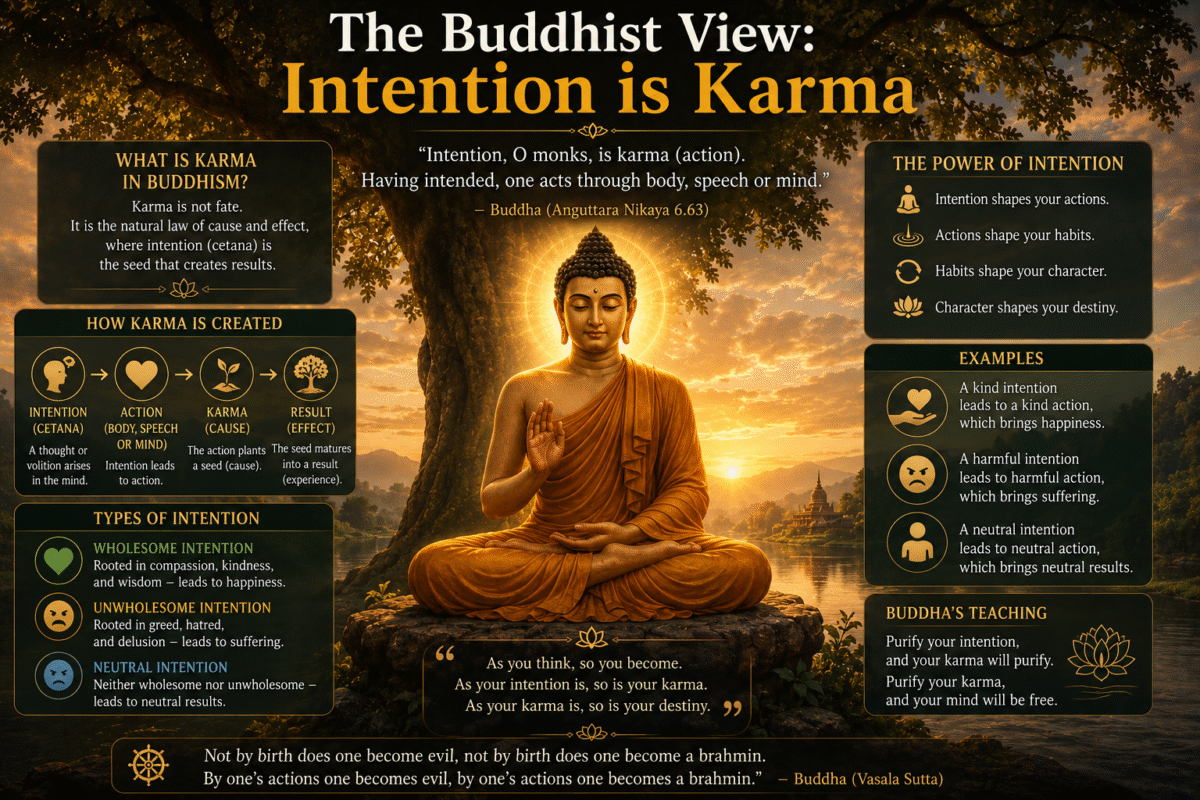
Buddha gave a very clear teaching on karma. He said that intention is karma. This means that the moral and psychological quality of action depends on the intention behind it.
If we speak harshly with the intention to hurt, that creates one kind of karma. If we speak firmly with the intention to guide or protect, that creates another kind. If we remain silent out of wisdom, that is one karma. If we remain silent out of fear or manipulation, that is another karma.
This is a very refined understanding. It teaches us to look within. Before acting, ask: What is my intention? Is it coming from ego or wisdom? From fear or love? From jealousy or goodwill? From selfishness or responsibility?
In Buddhist psychology, unwholesome roots are greed, hatred, and delusion. Wholesome roots are non-greed, non-hatred, and non-delusion. Every thought arising from greed, hatred, or delusion creates suffering. Every thought arising from generosity, compassion, and wisdom creates freedom.
This is not blind belief. We can observe it in daily life. When we think with hatred, our own mind burns first. When we think with compassion, our own heart becomes lighter first.
Modern Science and Karma
Modern science may not use the word karma in the traditional spiritual sense, but many scientific ideas support the practical side of karma. Neuroscience says that repeated thoughts and behaviours strengthen neural pathways. This is often explained by the phrase: neurons that fire together wire together.
If the mind repeatedly worries, the brain becomes trained in worry. If the mind repeatedly complains, complaint becomes natural. If the mind repeatedly practices gratitude, gratitude becomes easier. If the mind repeatedly practices mindfulness, awareness becomes stronger.
This is called neuroplasticity. The brain can change according to repeated experience. This means our inner training matters. Every day, through thoughts, emotions, speech, and actions, we are shaping the brain and nervous system.
Psychology also says that beliefs influence behaviour. Behaviour influences results. Results then reinforce beliefs. This becomes a cycle. For example, a person who believes “I always fail” may avoid effort or give up early. This creates poor results, which then strengthen the belief. This is a karmic loop at the psychological level.
Mindfulness helps us break such loops. It allows us to see thoughts before they become automatic reactions. Once we see them, we can choose differently.
How Thoughts Shape Emotions
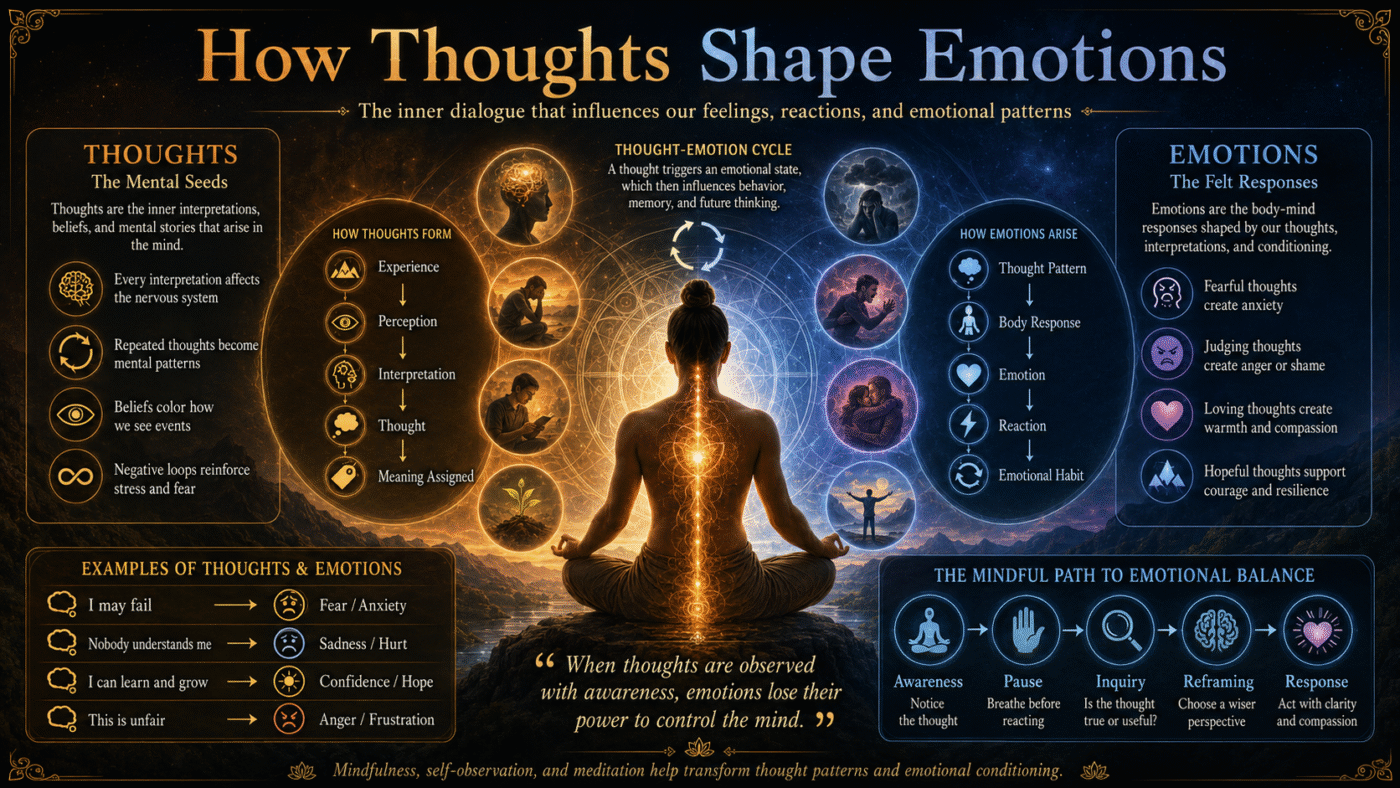
Every thought has an emotional vibration. If we think fearful thoughts, anxiety increases. If we think angry thoughts, heat and tension increase. If we think resentful thoughts, bitterness grows. If we think grateful thoughts, the heart softens.
Thoughts and emotions feed each other. A thought creates emotion, and emotion creates more thoughts. This becomes a cycle.
For example, one thought arises: “Nobody respects me.” This creates hurt. Hurt creates more thoughts: “People always ignore me.” Then anger arises. Anger creates harsh speech. Harsh speech damages relationships. Damaged relationships then seem to prove the original thought. This is karma working through thought, emotion, speech, and action.
A mindful person can break the chain early. When the first thought arises, he or she can observe: “This is a hurt thought.” Then instead of reacting, one can breathe, reflect, and respond wisely.
This is how awareness changes karma.
How Thoughts Shape Speech
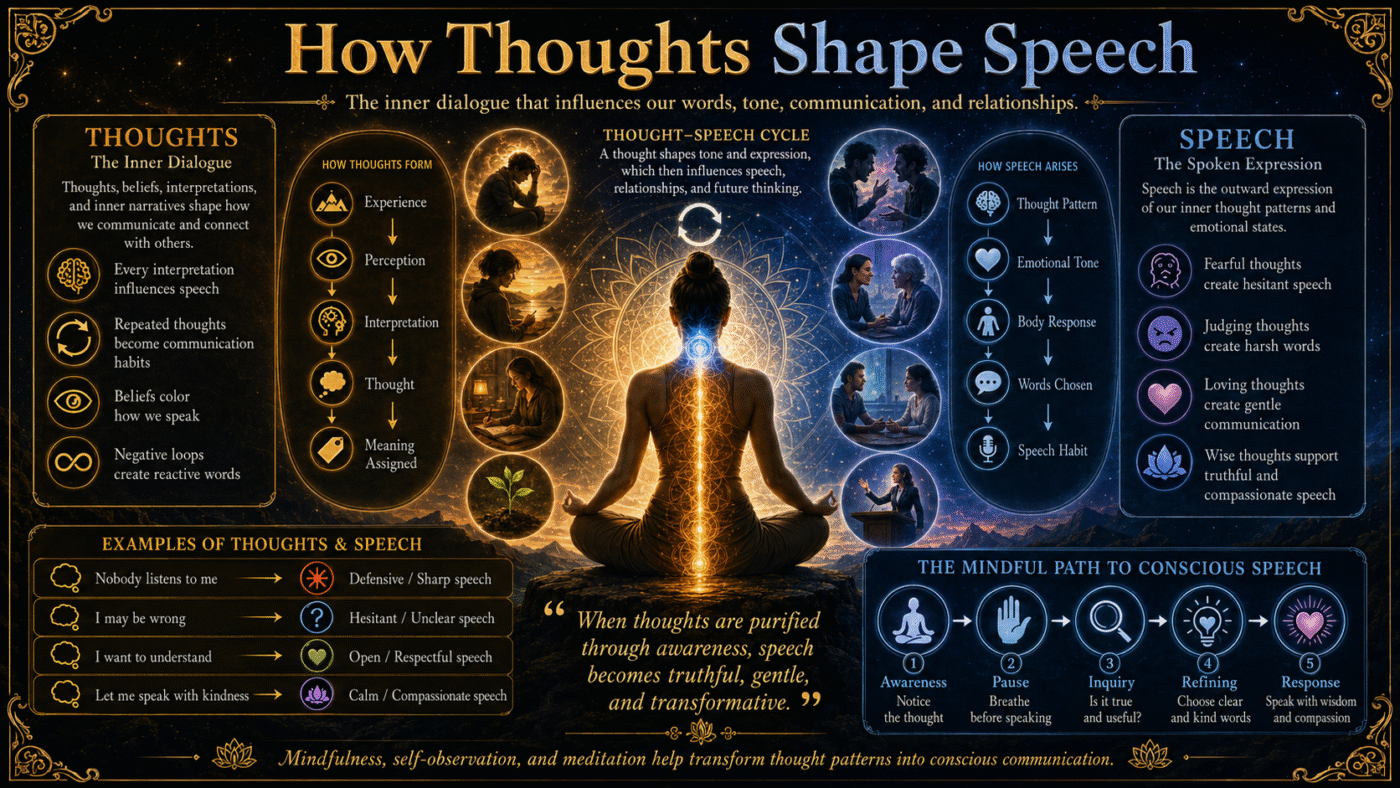
Speech is one of the most powerful forms of karma. Words can heal or harm. Words can build trust or break relationships. Words can inspire or discourage. But before speech comes thought.
If the mind is full of irritation, speech becomes sharp. If the mind is full of compassion, speech becomes gentle. If the mind is full of ego, speech becomes arrogant. If the mind is full of wisdom, speech becomes meaningful.
In Indian tradition, speech is considered sacred. Vak shakti, the power of speech, should be used carefully. In Buddhism, Right Speech is an important part of the Noble Eightfold Path. It includes truthful, beneficial, timely, and gentle speech.
Before speaking, we can ask: Is it true? Is it necessary? Is it kind? Is it the right time? Is it helpful?
This simple awareness can change our karma greatly. Many future conflicts can be avoided by one mindful pause before speaking.
How Thoughts Shape Action
Action begins in the mind. Before we do something, the seed appears as thought or intention. If we keep thinking about discipline, slowly disciplined action becomes possible. If we keep thinking about laziness, avoidance becomes easy. If we keep thinking about service, opportunities for service appear. If we keep thinking about revenge, harmful actions may follow.
This is why mental discipline is so important in Yoga. The Yoga Sutras speak about chitta vritti, the movements of the mind. If the movements are uncontrolled, life becomes uncontrolled. If the mind is trained, life becomes more conscious.
Karma is not only what happens to us. Karma is also how we respond to what happens. Two people may face the same difficulty. One becomes bitter, another becomes wise. The outer event may be similar, but the inner karma created from the response is different.
This means we are not helpless. Even when we cannot control circumstances, we can train our response. This is spiritual strength.
Habit Formation: Karma in Daily Life
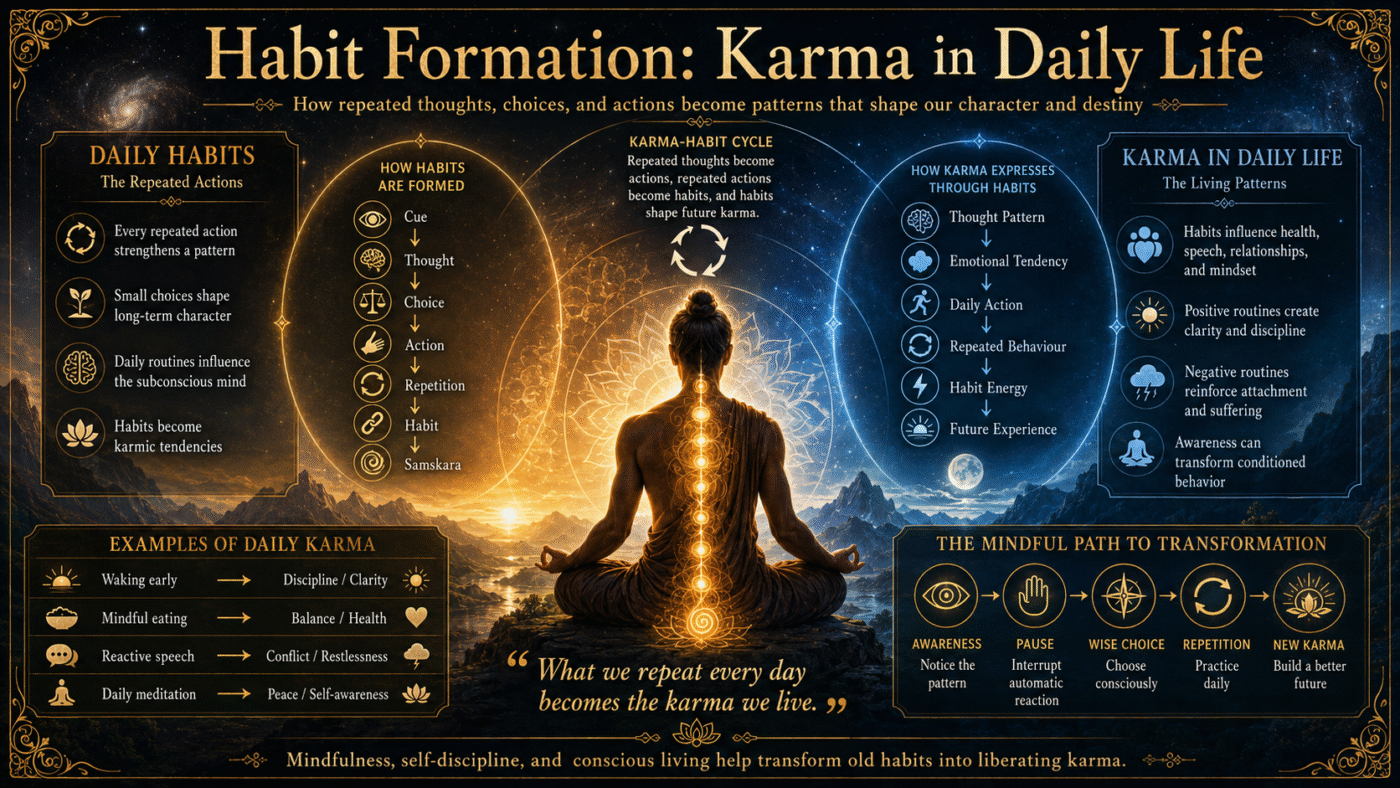
Daily habits are visible karma. What we do repeatedly becomes our life. Waking up early or late, eating consciously or unconsciously, speaking kindly or harshly, exercising or neglecting the body, meditating or scrolling endlessly — all these are daily karmas.
Small habits may look small, but over time they become powerful. One day of unhealthy food may not harm much, but years of unconscious eating can create disease. One day of meditation may not transform everything, but years of meditation can change the mind deeply.
This is why karma should not be understood only as something mystical. It is very practical. Your daily routine is your karma in motion.
If you want a different future, begin with different daily actions. If you want different actions, begin with different thoughts. If you want different thoughts, begin with awareness.
Mindfulness: The Key to Transforming Karma
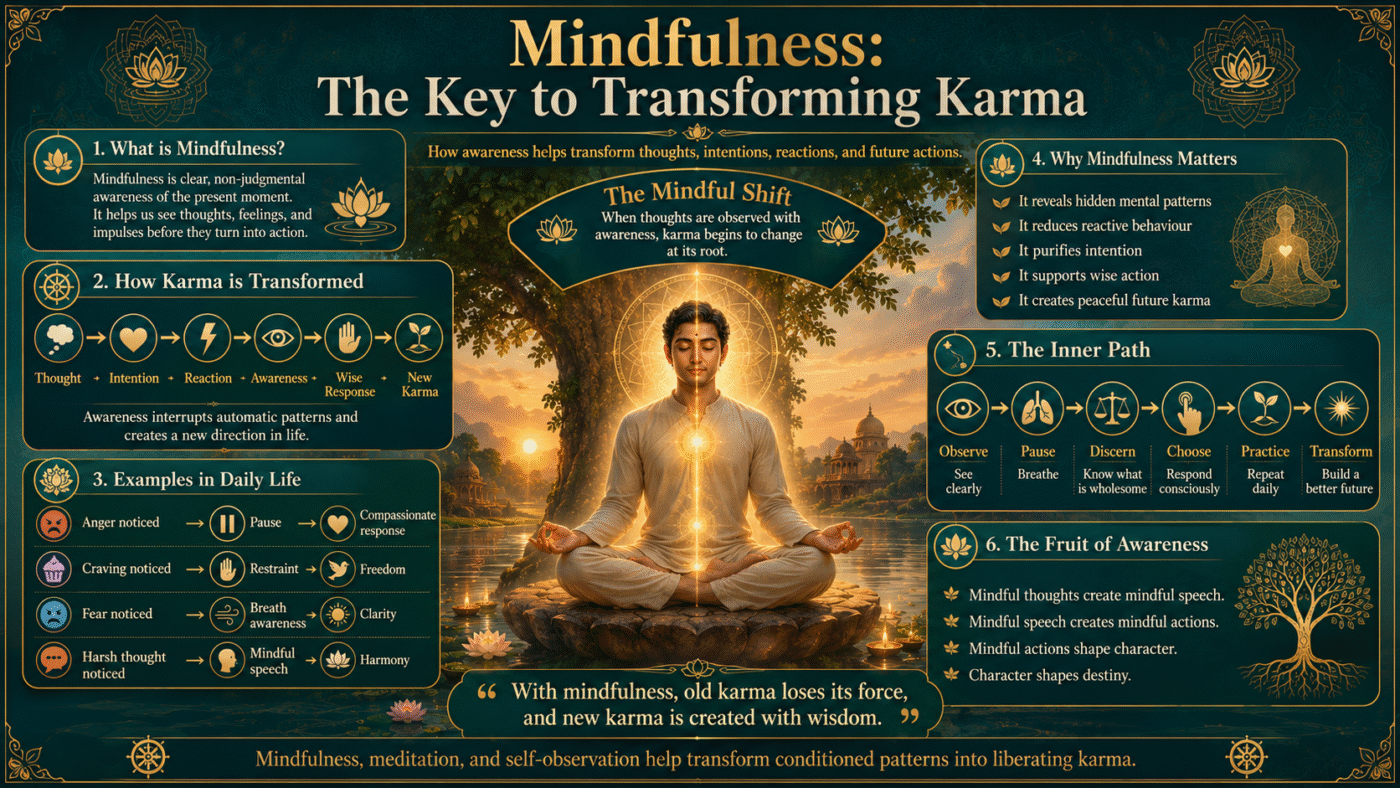
Mindfulness is one of the most powerful tools for transforming karma because it helps us see the beginning of action. Normally, we act automatically. Someone says something, we react. A desire arises, we follow it. Fear arises, we avoid. Anger arises, we speak harshly. This is unconscious karma.
Mindfulness brings light into this automatic process. It allows us to see the thought, emotion, and impulse before action happens. In that seeing, choice becomes possible.
For example, anger arises. Without mindfulness, anger becomes speech or action. With mindfulness, we notice anger as energy in the body and thought in the mind. We breathe. We wait. We choose a better response. That one mindful pause changes karma.
This is why mindfulness is not just a relaxation technique. It is a karmic transformation practice. It changes the future by changing the present response.
Karma and Free Will
A common question is: if karma exists, do we have free will? The answer is yes, but it is not absolute in the beginning. Past karma influences our tendencies, situations, and mental patterns. But present awareness gives us the power to choose differently.
Suppose someone has a strong habit of anger. That is past conditioning. But when anger arises, if the person becomes aware and chooses silence or patience, new karma is created. Slowly, the old pattern weakens.
This is the beauty of the law of karma. It is not fatalistic. It is liberating. It says that the present moment has creative power. What we are today may be influenced by the past, but what we become tomorrow is influenced by how we live today.
Every mindful thought is a new seed. Every conscious action is a new direction.
Karma and Relationships
Relationships are one of the clearest places where karma becomes visible. The way we think about others shapes the way we speak and behave with them. If we repeatedly think with suspicion, relationships become tense. If we repeatedly think with appreciation, relationships become warm. If we keep remembering only past mistakes, love becomes blocked. If we practice forgiveness, healing becomes possible.
This does not mean we should tolerate harmful behaviour blindly. Wisdom is also necessary. Compassion must be balanced with boundaries. But even when we set boundaries, we can do it without hatred.
In relationships, the karma of thought is very powerful. Silent resentment, jealousy, comparison, ego, and expectation create subtle distance. Gratitude, respect, patience, and honest communication create closeness.
Before trying to change others, we should observe the thoughts we are feeding about them.
Karma and Health
Thoughts also influence health indirectly. Chronic stress, fear, anger, and worry affect the nervous system, hormones, digestion, sleep, immunity, and overall energy. Modern research shows that mental and emotional states have a strong relationship with physical well-being.
This does not mean that every disease is caused by negative thoughts. Such thinking can be harmful and unfair. Health depends on many factors: genetics, environment, lifestyle, diet, infections, age, and medical conditions. But thoughts and emotions do influence how the body responds, heals, rests, and functions.
A calm mind supports better choices. A stressed mind often chooses quick comfort. Mindfulness helps us eat better, sleep better, breathe better, respond better, and take care of the body more consciously.
So the karma of thought also shapes the karma of health through lifestyle and nervous system patterns.
Karma and Spiritual Growth
The deepest purpose of karma teaching is not fear. It is awakening. Karma teaches responsibility. It tells us that nothing inside us is meaningless. Every thought matters. Every intention matters. Every action matters.
But karma should not make us guilty. Guilt weakens the mind. Awareness strengthens the mind. If we have made mistakes, we can learn. If we have created harmful patterns, we can purify them. If we have hurt others, we can seek forgiveness and change behaviour. If we have lived unconsciously, we can begin conscious living today.
Yoga, meditation, mindfulness, mantra, prayer, seva, svadhyaya, and ethical living are all ways of transforming karma. They help us move from unconscious reaction to conscious action.
The goal is not only good karma. The deeper goal is freedom from bondage itself. When action is performed with awareness, wisdom, compassion, and surrender, it purifies the heart.
Learn Mindfulness to Transform Your Inner Patterns
If you want to understand your thoughts, emotions, habits, and reactions more deeply, mindfulness training can be very helpful. Mindfulness teaches you how to observe the mind before it becomes speech and action. It helps you recognize karmic patterns and consciously transform them.
Adwait Yoga School offers a Certified Mindfulness Teacher Training India program. The course consists of 3 levels, and each level trains students in different tools and techniques of mindfulness meditation. It is suitable for those who want to become mindfulness teachers, as well as those who want to deepen their own mindfulness practice for personal and spiritual growth.
The course is offered offline at Adwait Yoga School’s center and also online, making it accessible for sincere students and seekers. You can visit the Mindfulness Teacher Training Course page here:
Mindfulness is especially useful in karma transformation because it brings awareness to the root level: thought, intention, emotion, and reaction. When awareness enters there, the future begins to change.
A Simple Practice to Change Thought Karma
Sit quietly for 10 minutes every day. Close the eyes and observe the breath. Let the body become relaxed. Now observe the thoughts arising in the mind. Do not fight them. Do not follow them. Simply notice.
If a fear thought comes, say inwardly: “Fear thought.” If anger comes, say: “Anger is present.” If jealousy comes, say: “Jealousy is present.” If gratitude comes, say: “Gratitude is present.”
This simple labeling helps you stop identifying with every thought.
After observing for a few minutes, gently create one conscious intention: “May my thoughts become clear, kind, and wise.” Sit with this intention for a few breaths.
Practice daily. Slowly, the mind becomes more transparent. You begin to see your karmic patterns. Once you see them, you can transform them.
Conclusion
Karma is not only something from the past. Karma is being created in this very moment. Every thought, intention, word, and action is shaping the direction of our future.
The science of karma teaches that thoughts are seeds. Repeated thoughts become patterns. Patterns become habits. Habits become character. Character shapes destiny. Ancient Indian wisdom expressed this through karma, samskara, and vasana. Modern psychology and neuroscience express it through conditioning, habit formation, and neuroplasticity.
Both point toward the same practical truth: what we repeatedly think and do becomes who we are.
This understanding should not create fear. It should create responsibility and hope. If negative thoughts have shaped part of our life, conscious thoughts can reshape it. If old patterns have created suffering, mindfulness can transform them. If unconscious reactions have created bondage, awareness can create freedom.
Your future is not written only by outer circumstances. It is also written by your inner response. Every mindful breath, every kind thought, every truthful word, every compassionate action, every disciplined habit becomes a new karmic seed.
So be careful with your thoughts. They are not invisible and meaningless. They are subtle forces. They are the first steps of future action. They are the silent architects of destiny.
When thoughts become pure, speech becomes pure. When speech becomes pure, action becomes pure. When action becomes pure, character becomes pure. And when character becomes pure, life naturally moves toward peace, wisdom, and spiritual freedom.